Introduction
I want to describe how I am using conversational AI to explore more than fifty years of my own writing and records. This is a summary of a much longer paper I am working on. That paper is in part inspired by the work of Sue McKemmish and others at Monash University where I worked and still have an honorary status, whatever that means. It all leads to deeper philosophical issues on memory culture. Sue wrote a seminal paper 30 years ago*. My paper is an attempt to update some of this thinking to the current era
I began with a practical goal a few weeks ago: to organise a large collection of academic papers, reports, diaries, travel journals, correspondence, community documents, social media posts and personal reflections. This has been after several months of A.I. in a more narrow way, for report writing and traditional research, though I had dabbbled a bit in interrogating my politics, but not in a structured way. In terms of the most recent experience. I expected AI would help me write. Instead, it has helped me read and actively reflect upon my own past in an unexpected, novel, and revealing way.
By active reflection, I mean that as I looked at the screen, I could ask questions, receive responses, ask further questions, and continue exploring and adding the material from different angles at extraordinary speed and with great convenience. With all, there are up to a million words of text, as well as many images ( that I have not yet explored) .
What AI Contributed
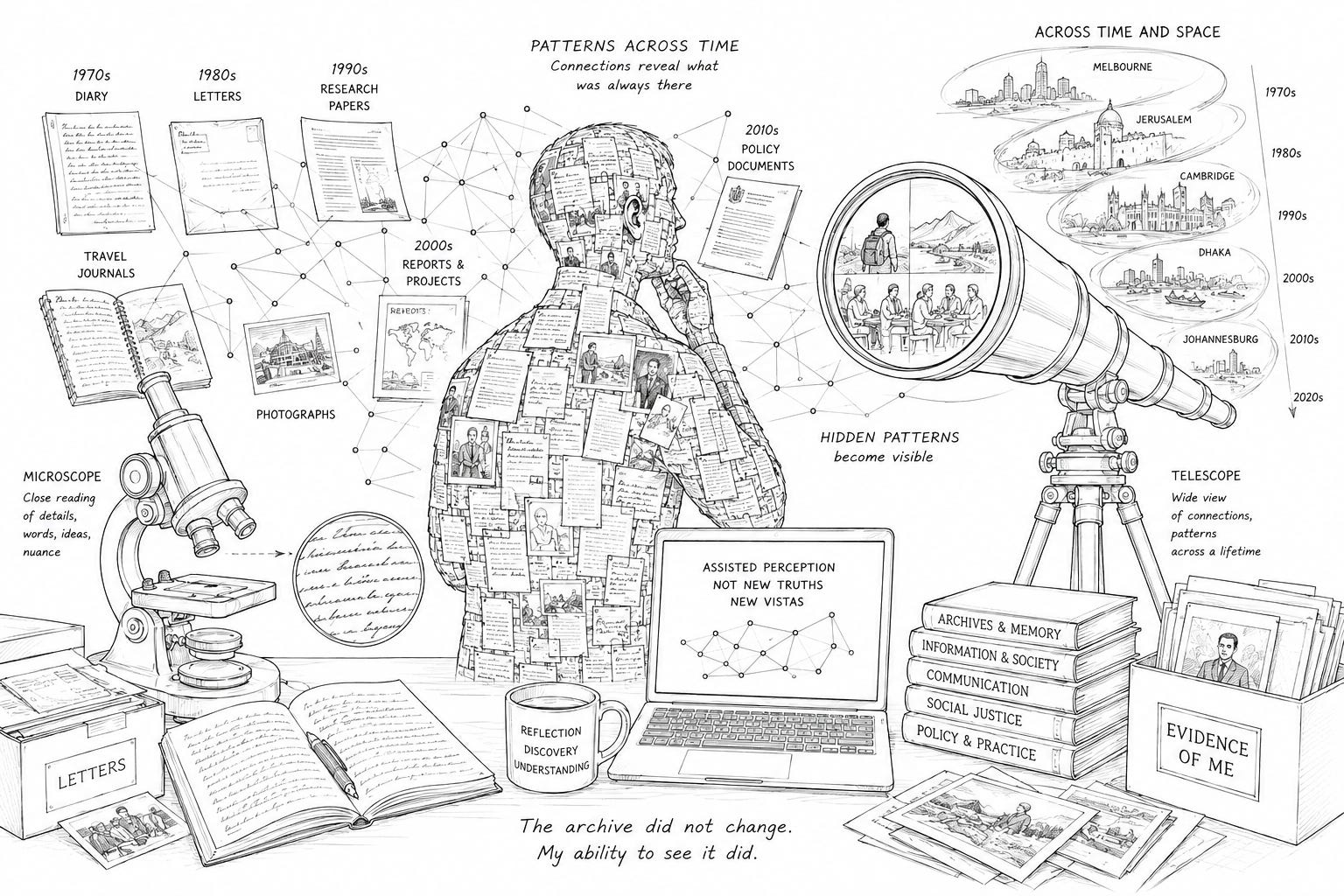
By bringing together documents written decades apart, AI helped identify patterns and connections over time that I had never consciously recognised. Projects that I had thought were separate—and had almost forgotten—often turned out to be linked by recurring interests and concerns.
The technology helped reveal long-term themes and changes in my thinking running through my work on archives, technology, communication, social justice, Jewish politics and public policy.
I never believed that AI somehow “understood” me or could discover hidden truths about my life by searching the internet. It could only work with the material I chose to provide and in response to focussed natural language questions. The ideas, experiences and documents were mine.
What AI contributed was the ability to search, compare and analyse a vast amount of material at a speed and scale beyond what I could manage on my own. The kind of archival work I was doing might once have required a major research project, but that was not my purpose. I was trying to understand my own accumulated record of experience as a process of reflection.
The best way I can describe the experience is that AI acted like a microscope and a telescope at the same time. It could examine individual documents in detail while also identifying language patterns and key ideas stretching across decades and across my experiences around the world.
It did not create those patterns. They were already present in the material. It simply helped make them visible.
Three Illustrative Examples
The following examples show how this process worked in practice.
Example 1: Analysing Evidence on Antisemitism and Social Cohesion
One example came from work I undertook on a 120 page submission presented to the Royal Commission into Antisemitism and Social Cohesion. This has been the largest piece of work I have undertaken since retirement.
Over many months I examined reports, surveys, witness statements and policy documents produced by different organisations. By comparing these materials, AI helped reveal a recurring methodological issue that became central to my analysis: what many reports described as measuring antisemitism often involved combining very different types of information under a single label.
The insight did not come from any one document. It emerged from comparing many documents at once and identifying patterns that would have been difficult to see manually.
Example 2: Discovering Themes Across a Lifetime of Writing
A second example involved my exploration of more than fifty years of my own writing. I had generally viewed different phases of my life as separate projects: work on information systems, archives, international development, community technology, public policy and Jewish communal affairs.
Yet when these materials were examined together, recurring themes repeatedly appeared. Questions of dialogue, mediation, communication, institutions, memory and social justice surfaced across very different contexts.
What I had experienced as intellectual wandering increasingly appeared as a long conversation conducted through different projects and periods of my life.
Example 3: The Idea of “Assisted Perception”
A third example arose from a simple phrase generated during one of my conversations with AI. While I was trying to describe what was happening, the phrase “assisted perception” appeared.
It seemed exactly right. But I immediately asked where it had come from. The answer led to a deeper exploration of how AI works. The phrase had not been copied from a particular source, nor had it emerged from conscious reasoning. Rather, it arose because ideas such as perception, interpretation, archives, pattern recognition and intellectual augmentation had become strongly connected within the conversation.
What fascinated me was that the phrase helped organise my thinking. It became a small example of the broader process described in the paper: AI generated a possibility, but its significance emerged only because I recognised it as meaningful.
Someone else might not have done so, and that is the key point. AI can help assemble information and present patterns, but human intuition, personality, values and priorities determine what becomes meaningful.
In that respect, it is like a great work of art or literature. A particular detail or phrase may resonate deeply with one person while leaving another unaffected. The human user remains in control.
Conversations with the Past
One of the most surprising discoveries was that my archive contained not only records of events but also records of earlier attempts to understand those events.
Old diary entries, letters and reflections were, in effect, conversations I had once had with myself. Through AI, those conversations became available again. Earlier versions of myself could, in a sense, enter into dialogue with the present.
With the help of AI, diaries, letters, emails, reports, photographs and personal reflections can become more than memories or stored information. They can become starting points for new conversations with our past selves, helping us see patterns, connections and changes that might otherwise remain unnoticed.
Opportunities and Challenges
Work that might once have taken months or years can sometimes be done in hours. This creates exciting opportunities for learning and discovery, but it also raises questions about information overload, exhaustion and the growing pressure to work at machine speed.
I have discovered that after a few hours of working in this way, I am often completely worn out. That is a real warning for anyone engaging in this kind of intensive reflection.
Facing Uncomfortable Discoveries
One final observation is worth making.
When exploring a large archive of personal records, the results are not always comfortable. Patterns may emerge that challenge cherished beliefs about ourselves. Forgotten mistakes may reappear. Contradictions, failures, regrets or embarrassing episodes may become newly visible. Some of the conclusions suggested by the evidence can be confronting.
A brief clarification is necessary. AI systems do not independently determine what is “comfortable” or “uncomfortable” for a particular person. They identify patterns, relationships, inconsistencies, recurring themes and other features within the material being examined. Whether those findings are experienced as reassuring, surprising, embarrassing or confronting is a matter for the human user. In this project I generally chose not to ask the system to avoid potentially uncomfortable topics. My interest was understanding rather than reassurance. The role of the AI was to help identify patterns in the evidence; the task of evaluating their significance, accuracy and emotional impact remained my own.
My own preference has been not to ask the system to filter out uncomfortable material. If the purpose of the exercise is understanding rather than self-congratulation, then it is important to remain open to what the evidence reveals, even when it is inconvenient or unsettling.
This does not mean accepting every interpretation produced by AI. Human judgement remains essential. Suggested patterns must be tested and questioned. But neither should we assume that only positive or reassuring conclusions are worth hearing.
One of the strengths of this approach is precisely its capacity to bring forgotten, neglected or uncomfortable aspects of our lives back into view. Sometimes the most valuable insights are not those that confirm what we already believe about ourselves, but those that challenge us to think again.
In that sense, AI-assisted reflection is not simply a tool for self-discovery. It can also be a tool for self-correction.
Conclusion
We should not fall into the trap of thinking that AI is a replacement for human thinking. Its real value may lie elsewhere. AI can help us explore, connect and reinterpret the records of our lives and work, revealing patterns and relationships that might otherwise go unnoticed.
The thinking, interpretation and judgement remain human. What AI provides is a powerful new way of seeing. Its greatest contribution may not be that it writes for us, but that it helps us discover insights that would otherwise remain hidden.
I also realize that I have entered into the risk zone by uploading so much material others may not be comfortable, but there is really not too much that is embarrassing. I’m not yet too fussed that it is one of trillions of chopped up bits in a data farm. And I can delete it (assuming it actually follows the stated policy). There are bigger issues to be concerned with about A.I. evils. That will be another paper.
*McKemmish , S. (1996) “Evidence of me”, Archives & Manuscripts, 24(1), pp. 28-45. Available at: https://publications.archivists.org.au/index.php/asa/article/view/8543
Note: This was written with A.I. assistance. The image is A.I.