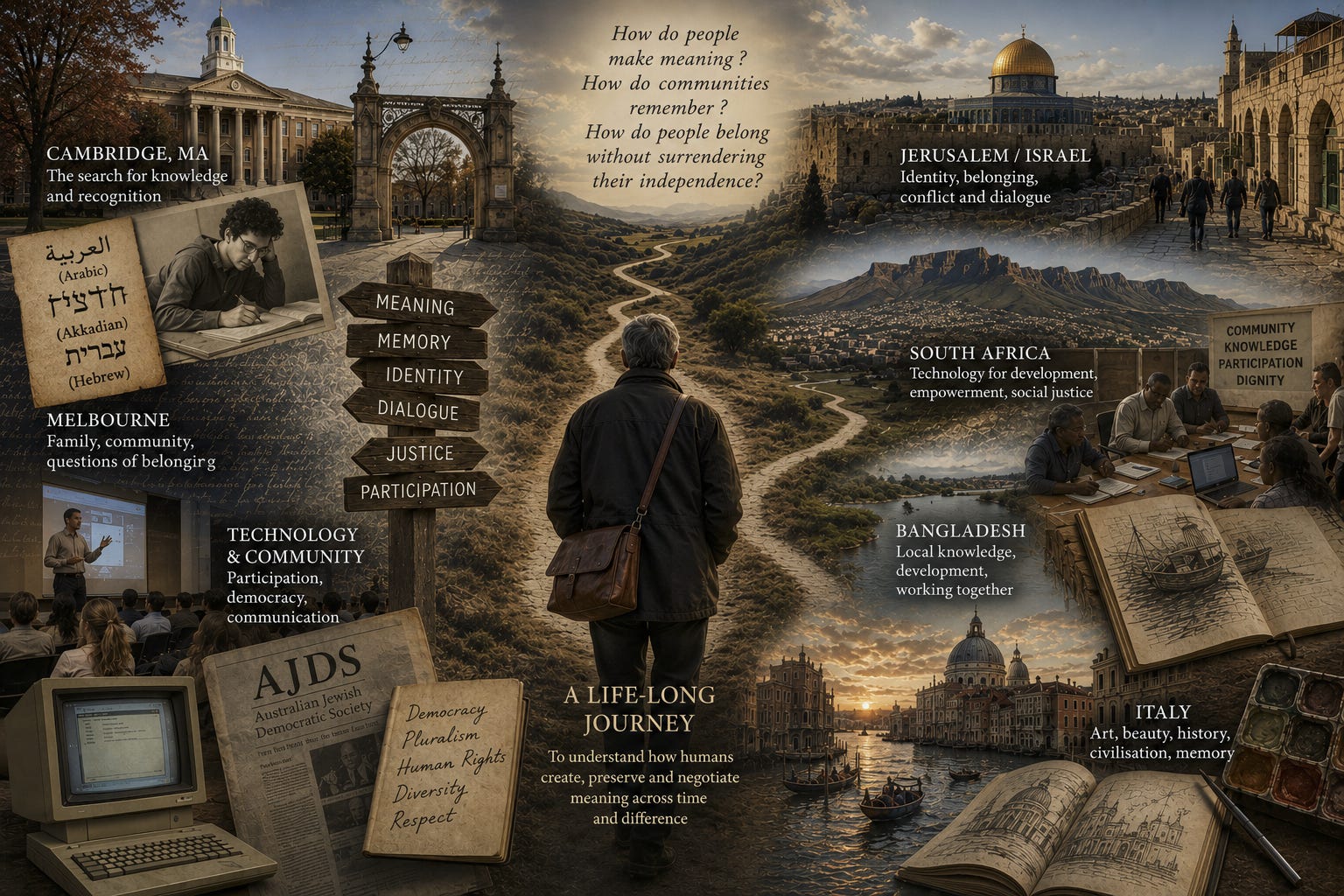
No, I am not turning the lights out. I'm taking advantage of the new tools to engage in self-reflection on the million words or so since the 1990s that I have produced.
It has been a very interesting few hours. I uploaded around 15 years of FB material to ChatGPT except for credit cards etc., on top of perhaps 100 files of other writing and academic material going back to about 2005 and even much earlier for some things. It’s around a million words, so there must be something in it. If Monash University had not lost (yes) my backups of earlier materials, that word count would have gone way up, including emails. In some respect, this is like going though through a shoe box of old letters, but rather more like a shoe shop. In fact, it would be an interesting exercise to scan old letters (but I threw most of them out…too much early angst in there), and type-written material. There are lots of letters to the editor, articles in print etc.
I now have a very long analysis of what I have done/not done/and the connecting threads.
Some people devote a couple of years to an autobiography (I think in fact there is a lot of fiction in some), but I am too lazy now for that, not that vain, and I can’t remember anything (the smoke haze). But there IS the archive of bits and bytes to play with. Lots of it. It is a great pity that all the material on early community sites and various discussion platforms has gone missing. The Wayback machine doesn’t have too much. No one thought about storing material for the future back then (or at least, few institutions/services did). Is there any overarching theme? It appears that many matters I thought were separate aspects of my work life and other interests are, in fact, deeply connected. AI is great at identifying patterns.
Languages, texts, identity, politics, technology, education, travel, art and community activism and development all seem to circle around the same underlying questions: how do people make meaning, how do communities remember, and how do people belong without surrendering their independence? Early on I thought I had to commit myself to class analysis and historical materialism, but I never mastered the theoretical arguments details sufficiently and how to apply them to what I was interested in. I have been primarily interested in how meaning, identity, memory, authority and belonging are constructed and contested in social life. That certainly is a common thread in the journey from Melbourne to, Jerusalem, Harvard, Joburg, Dhaka, Italy and back again and again.
Sometimes, almost always, my interests lay outside formal disciplinary and even work boundaries. The result is a more complex picture of a lifelong interest in memory, interpretation, dialogue and the ways people understand themselves and others. The same things come up again and again, even in my attempts to write about art or my interest in bookbinding. I love being able to track the history of a book I am restoring. I started out wanting to become a scholar of ancient languages; and despite different sorts of jobs and a drift into the sociology of IT, and a sort of community advocacy, there is a consistency in trying to understand how human beings preserve, transmit, contest and reinterpret meaning across time and space.
From a Bourdieusian perspective, I became a broker, translator and interpreter between worlds. It's amazing that AI came up with this, because it is something I have explained to people for years about what I think I do best.
This helps explain something that has taken me many years to understand. My goal was never really fame or academic prestige or status. Perhaps that is why I didn't have a great formal academic profile. What mattered to me was influence rather than visibility. Influence occurs in conversations, organisations, archives, projects, teaching, writing and relationships. It appears when ideas circulate, when communities learn from one another, when excluded voices gain recognition, or when a debate becomes more nuanced than it was before. It is something that is increasingly undervalued in a metric-driven society.
The places that most shaped me illustrate this journey. The United States represented a search for scholarly recognition. Israel confronted me with questions of identity, belonging and memory. South Africa taught me that knowledge matters only insofar as it enables participation and empowerment. Bangladesh reinforced the importance of local knowledge and community agency. Italy reminded me that civilisation, beauty and memory are themselves forms of human meaning-making.
So there. The sentences here have been mostly AI-generated. The evidence, experiences, values, memories and intellectual concerns are my own and AI has drawn on them. The result is a collaborative act of interpretation rather than authorship in the conventional sense. AI did not invent new ideas or opinions. Rather, it acted as a kind of analytical mirror, identifying recurring themes, connections and patterns across material I had written over forty years. The words are often its words, but the underlying ideas, experiences, values and concerns are drawn from my own writing and life. In that sense, the process was closer to an intellectual biography or extended interview than to ghost-writing. It's also time that we be honest that AI can, in certain circumstances, be a wonderful tool (I just wish it was all solar powered, however).