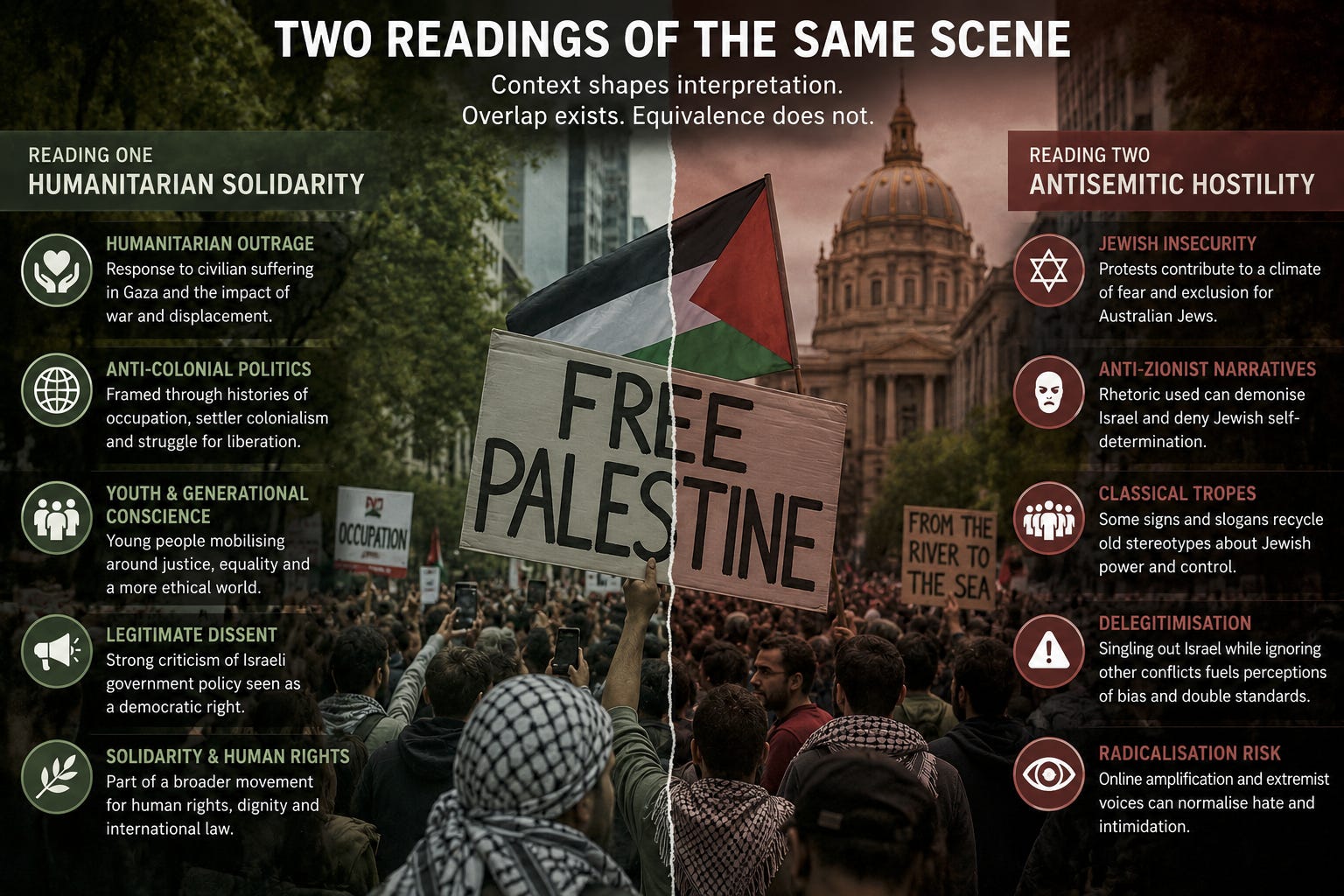
Professor Andrew Markus’s testimony before the Royal Commission into Antisemitism and Social Cohesion may prove some of the most politically significant evidence heard so far. Unlike more polemical witnesses, Markus refused to collapse anti-Zionism into antisemitism, even while acknowledging that parts of contemporary anti-Israel politics can overlap with older antisemitic tropes. His evidence suggested something more unstable and complicated: a combustible mix of humanitarian outrage over Gaza, generational political realignment, anti-colonial thinking, distrust of institutions, and social media radicalisation, alongside genuine antisemitic currents. Crucially, Markus repeatedly resisted simplistic conclusions. Asked directly whether strong anti-Zionist sentiment among Greens voters meant they were antisemitic, he answered: “No.” That qualification cuts against much of the rhetoric surrounding the Commission. Yet his evidence also challenges sections of the left by raising uncomfortable questions about conspiratorial rhetoric, moral absolutism, and the dismissal of Jewish fear within some activist spaces.
Professor Andrew Markus’s testimony on May 12 2026 before the Royal Commission into Antisemitism and Social Cohesion deserves serious attention (The link here is to the transcript, the video can be viewed on the RC website). As one of Australia’s most experienced researchers on public attitudes and social cohesion, his evidence carries considerable intellectual authority. His concern about rising hostility toward Jews after October 7 is real and should not be dismissed.
One of the strengths of Markus’s evidence is that he avoids crude polemics. Unlike some witnesses before the Commission, he does not present antisemitism as a pathology confined to fringe neo-Nazi groups or the far right. Nor does he simply reduce every expression of anti-Zionism to antisemitism. Instead, he argues that antisemitic attitudes can emerge within progressive political cultures when anti-Zionist discourse becomes absolutist, conspiratorial, or morally totalising.
There is substance to aspects of this concern. Conspiracy claims about “Zionist control”, collective blame directed at Jews for the actions of the Israeli state, or rhetoric that dismisses Jewish fear and historical experience altogether are genuine problems. Markus is right to insist that progressive politics is not automatically immune from prejudice simply because it speaks the language of human rights.
Yet Markus’s own evidence repeatedly complicates the far broader claims now circulating in sections of the organised Jewish community and political establishment — namely, that anti-Zionism and antisemitism are effectively interchangeable, or that “the left” has become inherently antisemitic. In fact, Counsel Assisting the Royal Commission, Zelie Heger, probably asked the killer questions for the hearings, ones that go to the core of the political debate over claims that there is a “new antisemitism” based around a fundamental hostility to Israel and Zionism that dovetails with traditional antisemitism. That view has certainly been put forward assertively by other witnesses.
One of the most revealing exchanges in the hearings came during discussion of Greens voters, when Heger noted that Greens voters recorded the “highest percentage of agreement with negative views on that anti-Zionist subscale” among the political groupings examined. But when asked directly whether this meant that “30 per cent of Greens voters are antisemitic”, Markus answered plainly: “No.”
That answer cuts against much of the public rhetoric surrounding the Royal Commission.
Gaza, Generational Politics and the Left
Since October 7, there has been a persistent tendency in some political and communal discourse to collapse hostility toward Israeli policy, Zionism, or the Gaza war into antisemitism itself. Markus repeatedly resisted doing this. Discussing younger respondents who agreed with the statement that “Israel treats the Palestinians like the Nazis treated the Jews”, he described the finding as “very strong”, particularly because agreement rose to 54 per cent among 18–24 year olds. Yet he still refused to reduce this automatically to antisemitism, suggesting instead that such views may reflect humanitarian concern, generational politics, or moral outrage about Gaza.
This is precisely where Markus becomes more interesting — and more politically inconvenient — than some of the Commission’s more sweeping narratives.
His evidence points to something far more complex than a simple resurgence of classical Jew-hatred. What emerges instead is a volatile political and cultural mix shaped by humanitarian identification with Palestinians, generational political realignment, anti-colonial frameworks, distrust of institutions and mainstream media, and the radicalising effects of social media environments. In some cases, these currents may overlap with older antisemitic tropes or conspiratorial narratives, particularly around Jewish power, media influence, or Holocaust instrumentalisation. But overlap is not the same thing as equivalence. Markus repeatedly resisted the claim that anti-Zionism itself is inherently antisemitic.
The broader survey findings further complicate claims of a society consumed by anti-Jewish hostility. Markus noted that 15 per cent of respondents in the Scanlon Social Cohesion survey expressed negative attitudes toward Jews — lower than negative attitudes toward Muslims, which stood at 35 per cent. These are not trivial figures, but neither do they support the more apocalyptic rhetoric that has sometimes surrounded the hearings.
At the same time, Markus’s evidence exposes the conceptual instability at the heart of much contemporary antisemitism discourse. He relies partly on an “anti-Zionist antisemitism subscale” designed to measure attitudes toward Israel and its supporters (whether or not the survey subscale is valid is another question). Yet he simultaneously insists that agreement with anti-Israel propositions does not necessarily make someone antisemitic.
That tension matters. If strong hostility toward Zionism may stem from humanitarian concern, anti-colonial politics, or moral opposition to Israeli state violence, then the classificatory boundaries become far less clear than much public discourse suggests. The danger is that contested political positions begin to slide into narrowly defined categories that ignore more complex realities.
How Zionist Witnesses Might Respond
Many strongly Zionist witnesses, including representatives of organisations that gave evidence, would probably respond to Markus in an ambivalent or even hostile way. On the one hand, his evidence gives empirical support to the claim that hostility linked to Israel and Zionism has intensified, particularly among younger people, university cohorts, and sections of the progressive left. Organisations such as the ECAJ, CSG, AUJS and the Zionist Federation would likely see his findings as corroborating what they describe as a hostile social climate. The same would apply to the Special Envoy Against Antisemitism (ASECA).
In particular, the very high agreement levels among younger respondents on questions comparing Israel with Nazi Germany would likely be interpreted by many communal witnesses as morally alarming and psychologically threatening, regardless of Markus’s caution about classification.
Yet it is likely that many young people have little else to compare Gaza to, propaganda aside. If Israel presents itself as a democratic state, then younger (and even older) observers cannot necessarily be expected to draw parallels with Sudan, Yemen or elsewhere, because those conflicts are not experienced in “real time” in the same way. They reach instead for European historical parallels, though it is a pity that many appear unfamiliar with the Balkan Wars. Even then, had they drawn parallels with ethnic cleansing in the former Yugoslavia, it is likely that similar accusations of blood libel or delegitimisation would still have emerged from Israel and local defenders.
Many Zionists would also focus heavily on Markus’s correlations. His evidence that some respondents who endorse strong anti-Israel narratives also endorse classical antisemitic tropes — such as Jewish media power or Holocaust manipulation— would likely be treated as confirming a central argument advanced repeatedly during the hearings: namely, that anti-Zionism can function in practice as a contemporary vehicle for antisemitism.
Yet other aspects of Markus’s testimony may prove uncomfortable for parts of the Jewish community. Throughout the hearings he repeatedly refused categorical equivalence between anti-Zionism and antisemitism. He insisted that context matters, that anti-Israel responses are not necessarily antisemitic, and that humanitarian concern may explain at least some of the attitudes revealed in the surveys.
For more hardline advocates of expansive IHRA interpretations — especially those who regard anti-Zionism itself as inherently antisemitic because it denies Jewish self-determination — Markus’s reluctance to make that leap may appear evasive, insufficiently firm, and politically weak. He treats anti-Israel hostility sociologically and contextually rather than as automatic proof of racial hatred.
This reveals a deeper tension running through the Royal Commission itself. Markus’s evidence partly supports the communal narrative that hostility toward Israel and Zionism has become entangled with antisemitism in some progressive political spaces. But it also places important limits on that narrative by insisting on ambiguity, contextual interpretation, and the legitimacy of at least some anti-Zionist or strongly anti-Israel political positions.
How the Left Might View Markus
Many on the left would likely view Markus in similarly ambivalent terms. Some would acknowledge that he is considerably more careful and intellectually serious than witnesses who simply collapse anti-Zionism into antisemitism. They would note that he repeatedly refuses to classify Greens voters or younger pro-Palestinian activists as inherently antisemitic, and that he explicitly recognises humanitarian concern, anti-colonial politics, and moral outrage about Gaza as important drivers of contemporary political sentiment.
At the same time, many left critics would remain deeply suspicious of the broader framework within which his evidence operates. The very existence of an “anti-Zionist antisemitism subscale” would be seen by some as ideologically loaded, subtly constructing anti-Zionist politics as inherently suspect even while verbally denying simple equivalence. Others would argue that the surveys risk pathologising intense opposition to Israeli policy while paying far less attention to anti-Palestinian racism, Islamophobia, or the political effects of the Gaza war itself within Australian society.
This view certainly appears in arguments that the focus on antisemitism in Australia functions as a diversion from the crimes in Gaza or from other endemic forms of racism that are viewed as equally serious, or worse. However, this response can itself become blinkered. The Royal Commission exists because the worst terrorist attack on Australian soil targeted Jews, not another group. Had it targeted Muslims, one would expect a similarly high-level inquiry, though there would no doubt still be fierce debate over its terms of reference.
Despite this, activists and anti-colonial thinkers would likely reject the suggestion that elevated hostility toward Israel among younger cohorts is evidence of latent antisemitism. Instead, they would interpret it as reflecting a generational political realignment shaped by social media exposure to Gaza, distrust of established institutions, and the growing influence of colonial-settlelr frameworks. From that perspective, Markus’s findings would not necessarily reveal a resurgence of classical prejudice so much as a profound collapse in younger Australians’ willingness to accept older Zionist narratives about Israel and Jewish security, as well as drawing a parallel, between colonization and ethnic cleansing in Palestine and Australian history. Anger over here can become anger for over there.
More theoretically minded critics on the left would also probably focus on Markus’s use of potentially woolly correlations. They would argue that overlap between anti-Israel attitudes and antisemitic tropes does not itself establish ideological equivalence or causation. In their view, contemporary political cultures are often shaped by broader anti-establishment distrust, conspiratorial thinking, anger at Western power structures, and polarised online discourse. Markus’s evidence, they might argue, sometimes risks interpreting all such clustering primarily through an antisemitism lens. Similar problems emerge in some of the monitoring and incident reports produced by Jewish organisations.
Yet even many critics on the left would probably concede that Markus identifies something real and politically uncomfortable: namely, that some on the left can, at times, become dismissive of Jewish fear, tolerant of conspiratorial rhetoric, or morally absolutist in ways that blur the boundary between anti-Zionism and hostility toward Jews. While such people may be relatively few in number, some receive disproportionate visibility through social media amplification. It is also worth asking whether all of them should even be described as left wing as distinct from fringe contrarian or nihilistic political actors. These are precisely the kinds of figures Naomi Klein has written about.
The Problem of Classification
In this sense, Markus’s testimony cuts both ways. It lends support to the proposition that antisemitism can emerge within progressive or fringe political environments and that some anti-Zionist discourse can become entangled with antisemitic narratives. But it also implicitly rebukes simplistic or inflationary claims that collapse all intense opposition to Israeli policy into hatred of Jews.
All this has implications not only for debate about the left, but also for the increasing split within Jewish communities here and overseas. If anti-Zionism or radical criticism of Israel is not automatically reducible to antisemitism, or merely a product of Greens-style politics, then Jewish critics of Israeli policy cannot simply be dismissed as self-hating or beyond the communal pale. Perhaps they are operating from defensible moral frameworks, even if the language can sometimes be crude and the proposed solutions unrealistic.
Consequently, the significant problem raised by Markus’s evidence is not whether antisemitism exists — clearly it does — but whether contemporary frameworks, including the allegedly advisory IHRA definition, are capable of distinguishing between fundamentally different kinds of phenomena. Increasingly, political anger about Israel, anti-colonial ideology, online outrage, offensive rhetoric, intimidation, and explicit anti-Jewish hatred risk being aggregated into a single moral and statistical category. That may produce emotionally powerful narratives that mobilise fear and communal solidarity, but it can also blur analytical boundaries and distort public understanding.
Markus himself repeatedly retreats to the language of “patterns”, “correlations” and “context”. That caution matters because surveys do not simply measure antisemitism in a neutral or objective sense. They interpret complex political and emotional responses through classificatory frameworks that are themselves contested. The issue is therefore not simply whether antisemitism is rising, but how contemporary institutions define, categorise and interpret hostility connected to Israel, Zionism and Jewish identity.
The risks are not merely conceptual. Once expansive definitions become institutionalised through universities, government agencies, monitoring systems and public discourse, contested political positions can gradually become reclassified as forms of ethnic or racial hostility. That has profound implications not only for Palestine activism, but also for academic freedom, democratic dissent, and the future boundaries of legitimate political speech in Australia.
Ultimately, Markus’s testimony highlights the central challenge facing the Royal Commission: whether it is capable of distinguishing between antisemitism, political extremism, emotional overreach, anti-colonial ideology, online amplification, and legitimate — if sometimes harsh or offensive — political dissent.
Note: I watched all of Andrew Marcus, but also worked with the hearing transcript and AI in data analysis. The image is AI generated.