I’ve received some comments in response to the piece I published yesterday, so here is some more detail.
One of the recurring weaknesses in contemporary discussions of decolonization in Israel/Palestine is the tendency to assume that political transformation will naturally lead to social peace. Writers such as Jeff Halper (see the reference below) are stronger than many anti-Zionist commentators in recognising that Israeli Jews have genuine security concerns and that any post-colonial settlement must address them. Yet even Halper’s work leaves largely unexplored a question that has become increasingly pressing in the wake of repeated wars, terrorism, military occupation, October 7, and the devastation of Gaza: how can deeply antagonistic communities be prevented from returning to violence after a political settlement is reached? In fact, I suggest that fear of violence is what blocks so many Israelis from moving forward, and also explains the use of maximal violence). If the conditions that create fear are removed, much can be done.
Halper says in his book that “the project of decolonization now calls for a focus on a strategic and well thought-out program” and that there needs to be joint struggle, but from the rest of the left I see no strategic and thought-out program that acknowledges the dangers of mass violence, nor an acknowledgement of the need for joint struggle against the current structures of oppression. In fact, there is a continuing rejection of the “legitimization” of half the population (the Jews), who are eternally labelled as colonists. That goes nowhere. There are two resident populations. People need to move on, and accept this fact, even in this state of aggressive war by Israel. While it may stick in the craw of many people who see Israeli Jews as devoid of any right to dictate terms, they are actually part of the solution, and must be acknowledged as such. In fact, the kind of Jewish society the emerges in the future in the contested land may be vastly different to that which existed before. But it may take generations.
None of what I am saying below addresses the question of how such arrangements would be implemented in the current geopolitical environment, particularly given the policies of the Trump administration. But assume for the moment that there existed a sympathetic US regime and other international will to move ahead. The Geneva Accord, discussed below, set out in considerable detail the components of an international implementation and monitoring force and other post-conflict steps.
The wider literature on conflict resolution and post-conflict reconstruction offers some useful insights on where to go. Across a diverse range of cases—including Northern Ireland, South Africa, Bosnia, Rwanda and a range of post-conflict societies studied by the United Nations—a consistent finding emerges. Sustainable peace rarely results from constitutional reform or declarations of equality alone. Instead, successful transitions usually combine several interconnected processes: disarmament and demobilisation of armed groups, reform of military and police institutions, constitutional protections for minorities, power-sharing arrangements, transitional justice mechanisms, and long-term programs of reconciliation and social integration. This must apply to both sides. Simply yelling “de-Zionisation” , “decolonize” or “get rid of Hamas” “No PLO”, are not serious peacebuilding strategies but blockers.
The United Nations has developed extensive frameworks for what is known as Disarmament, Demobilisation and Reintegration (DDR). These programs recognise that collecting weapons is only the first step. Former combatants must also be reintegrated into civilian life through employment, education and social support. Otherwise, armed networks and grievances can persist long after formal hostilities have ended. Security-sector reform is equally important. Police, military and intelligence agencies must be restructured so that they serve all citizens rather than a single ethnic, religious or political group. Again, this is as much a challenge for Israel as it would be for Palestine, although the problems confronting each society are very different.
There are other proposals that move in a similar direction. The Aix Group economic proposals stress interdependence and shared development. Various civil-society initiatives such as the People's Voice Initiative and later peacebuilding projects emphasize reconciliation, dialogue and shared institutions. Some scholars influenced by consociational theory have proposed forms of power-sharing modelled on Northern Ireland, Belgium or Bosnia. A number of Israeli and Palestinian peacebuilding organizations have also explored truth-telling, joint education and narrative-sharing processes inspired by South Africa.
The non-government Geneva Accord of 2003, with later updates, one of the most detailed Israeli-Palestinian civil society peace proposals ever produced, for all its faults (including virtually abandoning the right of return for Palestinians) deals with the violence issue. The Accord did not simply divide territory and establish two states (that was the model at the time). It proposed extensive international monitoring, a multinational force, joint security committees, intelligence cooperation, border supervision, phased military withdrawal, restrictions on armed groups, and mechanisms for dispute resolution. It also envisaged educational, civil society and historical dialogue programs designed to encourage reconciliation and mutual recognition. In many respects, the Geneva Accord came closer to the broader peacebuilding literature than many contemporary political proposals. It recognised that peace would require not only a political settlement but also a durable security architecture capable of managing distrust during a long transition.
Yet the Accord also highlights the dilemmas that continue to haunt peacebuilding efforts. One of its most controversial provisions states that Palestine would be a non-militarized state. Critics have long argued that this creates an asymmetry at the heart of the agreement. Israel would retain a conventional military, intelligence services, defence industries and strategic deterrent capabilities, while Palestine would be denied equivalent military sovereignty. From a Palestinian perspective, this can appear less a framework of mutual security than the institutionalisation of a permanent imbalance of power. Supporters of the Accord responded that the provision reflects political realities rather than principles. Given Israeli fears arising from decades of war, terrorism and regional conflict, demilitarization was seen as a necessary confidence-building measure without which no agreement would have been politically viable.
The resulting tension remains unresolved to say the least. At the time, the Accord sought to reconcile Palestinian sovereignty with Israeli security through international guarantees, monitoring mechanisms and joint institutions. Whether such asymmetrical arrangements would now be perceived as legitimate by both communities remains an open question. As well as this the rivalry between Hamas (no one believes that Hamas is finished) and the PLO cannot be hidden as a real problem for the future governance of Palestine, democratic or otherwise. At the same time, there is an important distinction between a limited self-defence capability and the highly militarised apparatus of occupation, control and brute power over others that many critics identify with the contemporary Israeli military. The challenge is not merely whether force exists, but what kind of force exists, under whose authority, for what purposes, and with what constraints.
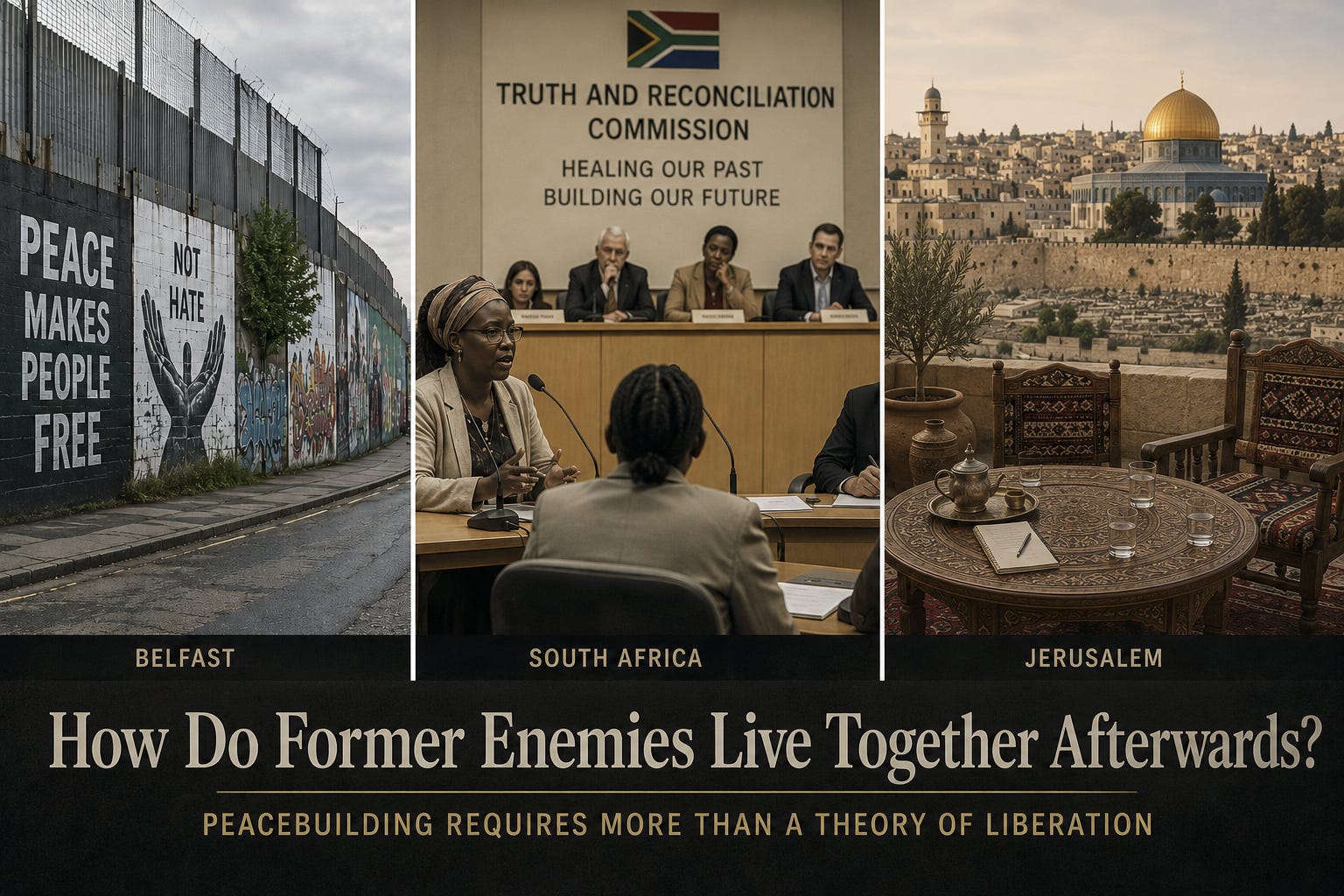
The experience of Northern Ireland is particularly instructive. The Good Friday Agreement did not simply ask Protestants and Catholics to reconcile. It established power-sharing institutions, reformed policing, reduced the military presence, oversaw the decommissioning of weapons, created cross-border institutions and provided mechanisms for managing ongoing disputes. Violence declined dramatically, yet distrust between communities remains significant more than twenty-five years later. Northern Ireland demonstrates both the possibilities and the limits of political agreements. Institutions can reduce violence, but they do not erase historical memory.
South Africa offers a different but equally important lesson. The transition from apartheid combined constitutional guarantees, integration of former security forces, democratic elections and the Truth and Reconciliation Commission. Yet even there, unresolved questions of justice and inequality continue to shape political life decades later. Reconciliation proved to be a process rather than an event.
What also strikes me is how underdeveloped these discussions often are within contemporary left-wing debates about Israel and Palestine. The language of decolonization, liberation and justice has become increasingly sophisticated. There is extensive discussion of settler colonialism, apartheid, human rights and historical dispossession. Yet there is often far less attention given to the practical questions that dominate the conflict-resolution literature. How are armed movements transformed into political actors? How are security institutions restructured? How are former enemies protected from one another during a transition? How are cycles of revenge interrupted? How are constitutional guarantees made credible? How are communities persuaded to surrender weapons when trust is absent? These are not secondary questions. In many post-conflict societies they become the central questions.
This is not a criticism of the pursuit of justice. Nor is it an argument for maintaining existing structures of domination. Rather, it is an observation that peacebuilding requires more than a theory of liberation. It also requires a theory of transition. The comparative experience of Northern Ireland, South Africa and other post-conflict societies suggests that the period after a political settlement may be as difficult and consequential as the struggle that preceded it.
What strikes me is how limited the discussion of these issues remains in contemporary debates about Israel and Palestine. Whether one supports two states, one democratic state, a confederation or some other arrangement, the same practical questions remain. How would armed groups be demobilised? How would security institutions be integrated or reformed? What mechanisms would prevent communal revenge and retaliatory violence? How would trust be rebuilt between populations carrying deep collective traumas? What role would international guarantees play in the transition? Would security arrangements be symmetrical or asymmetrical? How would competing historical narratives be acknowledged without reigniting conflict?
These questions do not invalidate visions of decolonization or a shared democratic future. But they do suggest that ending domination, occupation or inequality is only part of the challenge. The problem is not simply whether one supports two states or one state. The harder question is whether any proposed settlement can simultaneously satisfy three objectives that often pull in different directions: justice, security and political legitimacy.
The Geneva Accord remains one of the most serious attempts to balance those competing goals, yet even it reveals how difficult that balance is to achieve. People could have a look and think about it. Maybe others can take up the challenge again rather than engaging in theoretical speculation. The real challenge is how former enemies learn to live together afterwards without returning to violence.
Reading:
Jeff Halper Decolonizing Israel, Liberating Palestine, 2021.
Geneva Accord, 2003 https://geneva-accord.org/
[This original synthesis by Larry Stillman drawing upon conflict-resolution literature, the Geneva Accord, and comparative peacebuilding cases, developed through AI-assisted drafting and editing. It also draws upon my online archive of articles and idea that are used in the AI investigation]