I was trying to think of how to characterise Stephen Miller and truly horrible analogies came to mind, including people like Savonarola and various Israeli and European fascists, as well as the Jewish far right in the US. To have such a nasty schemer and bigot behind the golden Trump Throne is almost beyond comprehension. May he be defeated, quickly.
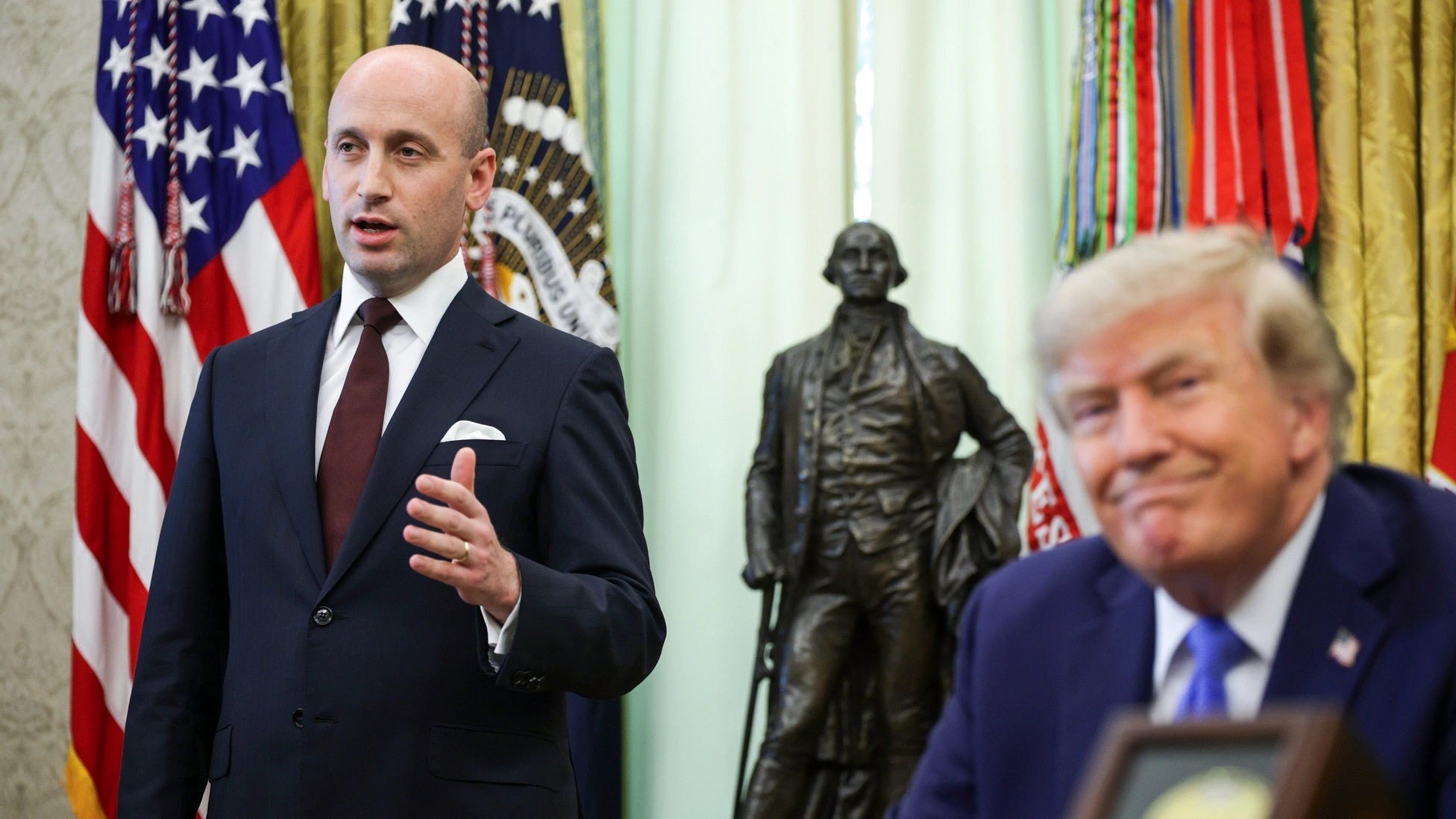
I put a few questions to Chat GPT, aware that a lot has been written about Miller’s politics and authoritarian psychology. A lot of what is summarized or commented upon isn’t particularly new, but it makes for scary reading, especially how Miller’s thinking bears some similarity to that of the conservative Nazi legal theorist, Carl Schmitt. I find even mentioning Goebbels almost beyond comprehension, but it is clear that Miller revels in cruelty against the weak and powerless, as any fascist thug, as well as putting on a media show.
So here is what Chat GPT did for me, with a few tweaks. Please only regard it as a machine generated literature and idea review that requires careful handling and follow-up.
The political outlook of Stephen Miller, one of Donald Trump's most influential advisers, invites comparison with several historical traditions of authoritarian nationalism. Particularly illuminating is the political philosophy of Carl Schmitt (1888–1985), the German jurist who became associated with National Socialism. Yet such comparisons require historical precision. Miller is not a reincarnation of Schmitt, nor is there established evidence that he consciously adopted Schmitt's writings. Rather, Schmitt provides an analytical framework for understanding the political logic that Miller exemplifies.
Schmitt's The Concept of the Political (1932) placed the distinction between friend and enemy at the centre of political life. In Political Theology (1922), he associated sovereignty with the authority to decide upon exceptional circumstances. His thinking challenged liberal pluralism and elevated political unity, decisive leadership and the identification of existential threats.
These ideas offer a revealing perspective on Miller's political language. His portrayal of immigration as a threat to national identity, his support for expansive executive power and his tendency to divide society into legitimate members and threatening outsiders display important structural affinities with Schmittian politics.
The comparison is not merely retrospective speculation. Political theorist William E. Scheuerman, writing in a 2023 scholarly exchange on Schmitt and democratic backsliding, analysed Trumpism through Schmitt's conception of political authority. More explicitly, Robert Kuttner compared Miller's language of strength, force and power to Schmitt in The American Prospect in January 2026.
Nevertheless, analogy must not become a claim of intellectual genealogy. Miller's documented engagement with white-nationalist and anti-immigrant material, revealed in emails investigated by the Southern Poverty Law Center in 2019, provides more direct evidence of his ideological influences than any supposed relationship with Schmitt.
Other historical comparisons illuminate different dimensions of his politics. Joseph Goebbels offers a disturbing, although necessarily limited, parallel concerning propaganda and the manufacture of threatening enemies. Charles Maurras represents an exclusionary nationalism rooted in hostility to liberal universalism. America's own immigration restrictionists, including those responsible for the Immigration Act of 1924, provide an especially pertinent historical precedent. Hannah Arendt, conversely, offers a critical framework for understanding how bureaucratic institutions can normalise exclusion and erode political belonging. These are comparisons of particular political mechanisms, not assertions that Miller's policies or their consequences are equivalent to those of Nazi Germany.
The profound historical paradox is Miller's Jewish background. His maternal ancestors escaped persecution in Eastern Europe, arriving in the United States when immigration offered refuge from violent antisemitism. His uncle, David Glosser, has publicly condemned Miller's policies as a repudiation of the very circumstances that made his family's survival possible. Glosser's account is especially powerful because relatives who remained in Europe were murdered during the Holocaust.
Miller's relationship to this inheritance should not be psychologised without evidence. We cannot know precisely how he interprets his family's history. Yet his public politics reveal a striking separation between the historical experience of Jewish vulnerability and the universal application of the moral lessons that might be drawn from it. A family history of persecution does not necessarily produce solidarity with other persecuted populations.
This paradox becomes more comprehensible when placed within the broader diversity of Jewish political experience. Jewish history has generated liberal universalism, socialism, Bundism, religious traditionalism, Zionism and several forms of nationalism. None is the inevitable expression of Jewish identity.
The rise of the Israeli far right illustrates this diversity with particular force. Figures such as Itamar Ben-Gvir and Bezalel Smotrich advance forms of Jewish ethnonationalism in which territorial control, collective identity and unequal political belonging assume central importance. Their historical and ideological origins differ from Miller's American nationalism, but they share an inclination to organise politics around the defence of a privileged national community against perceived existential threats.
The political influence of wealthy Jewish conservatives in the United States complicates the picture further. Miriam Adelson's substantial support for Trump and the Republican right demonstrates the compatibility, for some influential Jewish political actors, of strong attachment to Israel and support for exclusionary American nationalism. Jeffrey Yass's major Republican donations illustrate a different conservative political orientation, primarily libertarian and economically focused. These individuals should not be grouped into a single ideological category simply because they are Jewish, wealthy and politically conservative. We now also know of the billionaire backing for ideological capture of the Israeli military.
The larger historical lesson is that minority identity provides no automatic immunity against authoritarian ideas. Neither inherited memories of persecution nor membership in a historically persecuted people guarantees a commitment to pluralism, equality or universal rights. Conversely, Jewish critics of the far right draw upon the same historical inheritance to defend precisely those principles.
Schmitt therefore remains valuable as an analytical reference, not as a proven intellectual source for Miller. His political philosophy helps explain how the construction of enemies, the ideal of a homogeneous national community and the expansion of executive authority can reinforce one another.
Ultimately, the problem raised by Stephen Miller is not how a Jew could embrace such politics, as though Jewish identity necessarily prevented it. The more consequential question is how historical memory becomes selective: how the suffering of one's own community may be remembered intensely while the vulnerability of others is disregarded.
The enduring democratic challenge is to prevent the memory of persecution from becoming merely a justification for collective self-protection, and instead to sustain its potential as a foundation for universal human dignity.
REFERENCES AND SOURCES
Schmitt and authoritarian political theory
1. Schmitt, Carl. (1922). Political Theology: Four Chapters on the Concept of Sovereignty. English translation, University of Chicago Press, 2005.
2. Schmitt, Carl. (1932). The Concept of the Political. Expanded English edition, University of Chicago Press, 2007.
3. Karolewski, Ireneusz Paweł, et al., including William E. Scheuerman. (2023). “Carl Schmitt and Democratic Backsliding.” Contemporary Political Theory, 22, 406–437. Multi-author critical exchange; Scheuerman contributes a discussion of Trump as a Schmittian democratic backslider.
https://link.springer.com/article/10.1057/s41296-023-00625-5
4. Kuttner, Robert. (8 January 2026). “The ICE Murder and the Broader Battle.” The American Prospect. An explicit comparison of Miller's political language and Schmitt.
https://prospect.org/2026/01/08/ice-murder-broader-battle-minneapolis/
5. Arendt, Hannah. (1951). The Origins of Totalitarianism. Harcourt, Brace.
Miller's ideology and family history
6. Hayden, Michael Edison. (12 November 2019). “Stephen Miller's Affinity for White Nationalism Revealed in Leaked Emails.” Southern Poverty Law Center, Hatewatch.
https://www.splcenter.org/resources/hatewatch/stephen-millers-affinity-white-nationalism-revealed-leaked-emails/
7. Glosser, David S. (13 August 2018). “Stephen Miller Is an Immigration Hypocrite. I Know Because I'm His Uncle.” Politico Magazine. (Link below is a reproduced copy.)
https://readersupportednews.org/component/content/article/277/51710-focus-stephen-miller-is-an-immigration-hypocrite-i-know-because-im-his-uncle
8. PBS FRONTLINE. (2019). “David Glosser: Stephen Miller's Uncle.” Interview transcript, 21 June 2019.
https://www.pbs.org/wgbh/frontline/interview/david-glosser/
9. Whitman, James Q. (2017). Hitler's American Model: The United States and the Making of Nazi Race Law. Princeton University Press.
Israeli and American far-right nationalism
10. Magid, Shaul. (2021). Meir Kahane: The Public Life and Political Thought of an American Jewish Radical. Princeton University Press.
11. Reuters. (30 May 2024). “Republican Mega Donor Adelson to Back Major Pro-Trump Spending Group.” Evidence of Miriam Adelson's political financing.
12. Ulmer, Alexandra. (21 March 2024). “Republican Trading Firm Owner and TikTok Investor Yass Emerges as Top Donor in US Election.” Reuters.
https://www.reuters.com/world/us/republican-hedge-fund-owner-tiktok-investor-yass-emerges-top-donor-us-election-2024-03-21/
Note: This deliberately avoids describing Schmitt as Miller's intellectual mentor, treating Nazi comparisons as historical equivalences, or presenting Jewish nationalism, Jewish conservatism and Jewish identity as interchangeable categories. These distinctions make the argument more defensible without diminishing its critical force. Some people may fail to make this difference clear.