I’ve written beforeabout Mary Kostakidis’s lack of media discipline and collapse into what appears to be antisemitism or something close to it. She didn’t like what I wrote. In fact, she wrote a very angry response, that I like others was trying to stop her critical voice. Now as you know, she’s undergoing another round of legal proceedings, but I’ve got nothing to do with that. I’m more interested in analyzing a new post that she put online +
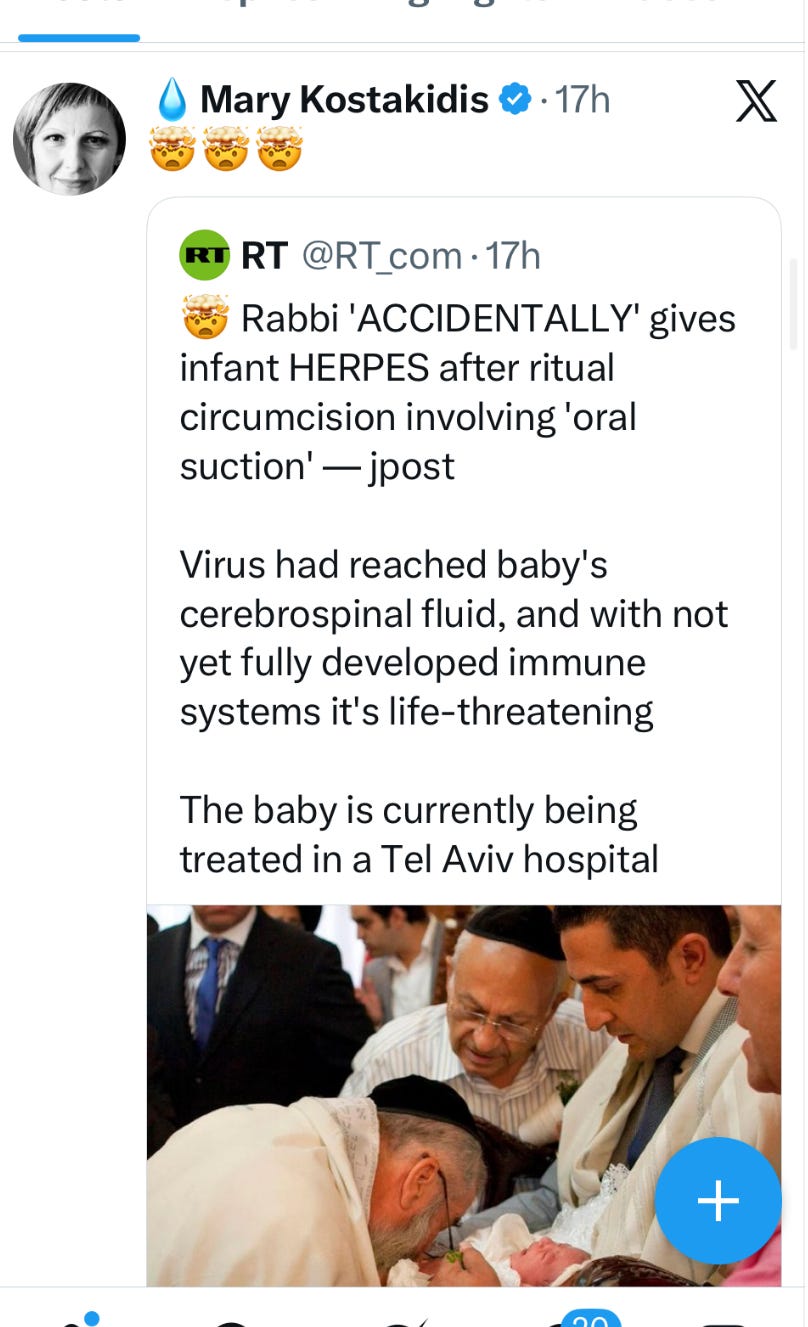
Here is the X post that I found a particularly offensive. Her posting lead me to ask why was she doing this? It clearly has nothing to do with the Gaza war, but something to do with posting for information that puts Jews into a bad light. That then led me into thinking about what is her world view as former TV journalist, and a frequent user of X. I then used AI in a very careful way to investigate various aspects of media theory, but as well, the worldview of a certain sort of anti—imperialist. I think the results are very interesting, though I have of course engaged in some editing. I already have a whole set of queries about the left, and he imperialism of various sorts attitudes towards Israel, Palestine, and so on, and I have been able to draw on that to help me. However, the final result is all my responsibility.
I also take up the issue of whether or not her post was deliberately or intentionally antisemitic and the effects on what is clearly an adoring audience, and I also got some help from AI. So you can claim my writing my interest in this topic is fake. My counter claim is that I’ve doing a lot of social science-type-research over the past couple weeks of and I think I’ve got a good handle on what is good and what is weak and what is bad and how to use AI to basically save a lot of grunt work. I’m actually writing research paper about that at the moment, and maybe I’ll put a summary online for you to read at some point point I have already had a rant in a previous post. So here we go
Over many decades, Mary Kostakidis has established herself as a trusted, credible presenter, or as they say, news anchor. She has become a powerful mediator of public understanding in Australia and has been rightly recognised for that. However, such a role can also serve as a potential amplifier of bias or error, Think that at times, because of her political passion and orientation, she has fallen into a bad trap.
The trusted TV presenter derives authority from institutional backing, familiarity, and performance of neutrality. Over time, audiences come to trust not only the information presented but the presenter’s judgement about what matters and how it should be interpreted. The TV anchor in the past was the person to trust for neutrality. Walter Cronkite, in the US, was for decades, the paragon of this kind of role.
But trust can convert interpretation into taken-for-granted reality by viewers and listeners, reducing scrutiny of sources and methods. When presenters move to platforms like X, this trust often persists even as institutional safeguards—verification, editorial oversight, and sourcing transparency—are reduced. Authority shifts from institutional processes to individual choice and perception of credibility, increasing both influence and the potential for error amplification. You are doing your own research advertising and product placement, based on your brand and reputation there is no editor working with you.
Kostakidis’ use of Twitter can now be understood as a form of interpretive, morally-driven practice, shaped in part by a critical, and at times insufficiently self-reflective, anti-imperialist perspective. This refers to a worldview that strongly critiques Western power but does not always apply the same level of scrutiny to non-Western actors or her own assumptions, potentially producing selective analysis. Sometimes, it works well, other times, it fails.
Her style privileges meaning : events are read as expressions of underlying systems of power and inequality. This produces coherence and moral clarity, but also introduces the risk of compression of complexity, where contingent realities are folded into broader structural interpretations without sufficient differentiation. Western power often becomes the primary explanatory frame, sometimes limiting engagement with internal diversity or alternative causal factors.
On social media interpretation and signals become compressed and affectively intensified, often stripped of visible sourcing and conveyed through selection and a few words, and tone rather than extended argument. This increases the likelihood of polarisation, confirmation bias, and misinterpretation, as audiences may be shown strong conclusions or provided with strong signals without clear evidentiary support.
Consequently, though Mary Kostakidis say at the start of her X feed says that posting something doesn’t mean endorsement, the very fact that she as a famous person has posted something means that it is there with a purpose. It to be read and acted upon on some that way. She has chosen it for you. It’s product placement. She can generate income as well. It pays to be provocative.
These dynamics are illustrated the above post where Kostakidis reposted a claim circulated by RT concerning an Israeli Jewish infant contracting herpes following a ritual circumcision, adding only shocked emojis. RT (formerly Russia Today) is a Moscow-based, state-funded broadcaster that positions itself as an alternative to Western media but is widely regarded as reflecting Russian government perspectives and strategic messaging. Reliance on such a source raises questions about editorial judgement and critical distance, particularly given its record of selective and politically inflected reporting.
The post exhibits weak evidentiary grounding. The claim appears in second-order form, with RT summarising a report attributed to The Jerusalem Post, but without direct linkage or verification (The Jerusalem Post report in fact showed revulsion at this practice). ‘Accidentally’ implies deliberately. All this produces an evidentiary chain that cannot be readily assessed. The absence of contextualisation compounds the problem: the report concerns a specific and controversial ultra-Orthodox practice, yet no information is provided about its rarity, internal debate in the Jewish community, or regulatory context. Yet the message is clear: blood sucking sex-abusing Jews. And the image has nothing to do with the story. It is a file photo. And the reference to a Rabbi is erroneous. The procedure was conducted by a ritual circumciser or not a rabbi, but it doesn’t matter because the use of the term rabbi has worse connotations
Framing operates through selection and affect rather than argument. The combination of a highly emotive story—infant, disease, religious ritual, rabbis, whole evil Jewish communities in turn- and shock emojis by Kostakidis encourages a moralised reading while bypassing analytical mediation. This produces “context collapse,” in which a specific incident is implicitly generalised without clarification of scope. The issue is therefore not factual falsity but slippage: sourcing is opaque, context is absent, and emotional signalling substitutes for verification. Outrage at Israel’s conduct (over which I have no issue), is backed up by dredging up a Jewish stereotype. Of course, it’s completely unnecessary to engage in this. Just stick with the fact of genocide in Gaza. Don’t connect it to antisemitic stereotypes This is where Mary Costa Keiters has failed, either intentionally or unintentionally. It’s hard to tell. But one’s psst , as a respected TV anchor, isn’t a sufficient defence.
This is best understood as compression of complexity, where nuanced material is condensed into rhetorically powerful but ethically weak forms. Jewish crimes of the worst sort. Gaza crimes of the worst sort .
Within contemporary antisemitism frameworks, this post occupies a boundary position rather than an absolutely clear case of antisemitism, though my view is that it does fall over the line. Under the International Holocaust Remembrance Alliance definition, it is not explicitly antisemitic, as it refers to a specific incident rather than making general claims about Jews. However, the combination of emotive framing, lack of contextualisation, and association of disease with religious practice creates a risk of negative stereotyping through inference. The Jerusalem Declaration on Antisemitism would be less likely to classify it as antisemitic, as it permits discussion of religious practices absent explicit hostility, though the signalling by Kostakidis and the use of a propaganda site sets the context. The Nexus Document similarly identifies the issue as one of risk and interpretive effect, rather than inherent antisemitic content. Yet Russia has a long history with this sort of material, and cartoons referring to Jewish ritual abuse are all too familiar.
The broader implications are significant. The compression of evidence via X coupled with various signals and the poster’s status means that audiences receive generalised conclusions without transparent reasoning, making evaluation difficult. These dynamics can reinforce echo chambers here it is an echo chamber about Israeli/Jewish moral corruption And the comments to her post demonstrate that.
What to do? I clearly don’t know. The law is a blunt instrument, and she sees herself the victim of Zionist forces, so I think she has a real blind spot In the current environment conviction, probably only inflame the situation and reinforce the view that Zionists control the narrative and and that and accusations are a put up job whether you call her a tankie or a campist it’s going to be pretty hard to get her to change . Maybe others need to talk to her about her problem.