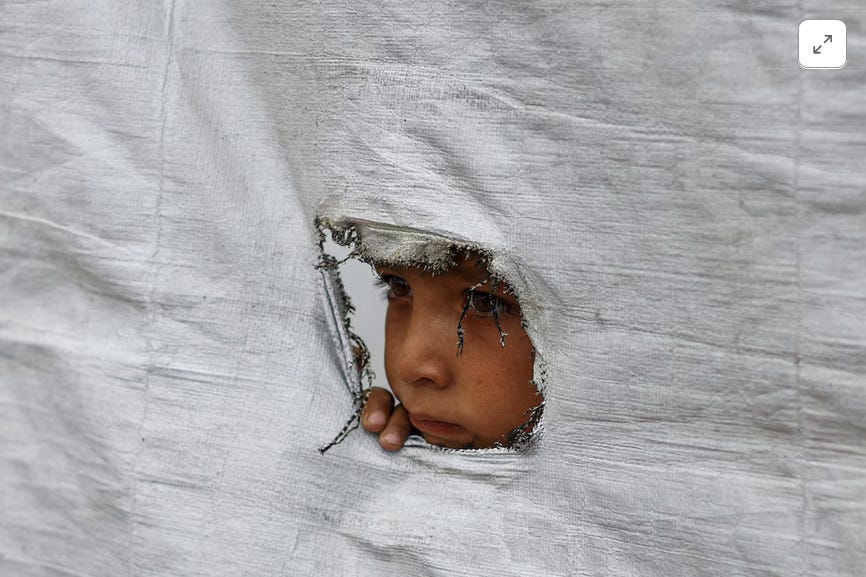
{REUTERS/Mahmoud Issart]
Orientation and Evidentiary Questions
The report discussed here is a “conference room paper” of the The Independent International Commission of Inquiry on the Occupied Palestinian Territory, including East Jerusalem, and Israel. The PDF can be found here. I found it distressing to read, to say the least. I wrote this opinion with some AI help as a means to understand the language and method of the document. For all the allegations of bias against the Commission of Inquiry, the general thrust of the inquiry — that these are crimes against children, cannot be wished away.
For many supporters of Israel, the report will be difficult to engage with because it challenges longstanding beliefs about the IDF’s doctrine of “purity of arms.” Because the allegations are so disturbing, the report and its recommendations may be rejected outright. For those who claim it ignores Hamas crimes, including crimes against children, it does not, though this report focuses on the far more numerous crimes against Palestinian children. See the summary below. Yet testimony from some Israeli soldiers, reports concerning particular military units, investigations by Israeli journalists, and accounts of increasingly remote forms of warfare, including drone and quadcopter operations, make outright dismissal by supporters of Israel difficult. The report itself also draws upon some Israeli sources and testimony, suggesting that its claims cannot simply be rejected as external hostility.
Accepting that allegations may threaten deeply held assumptions about Israel, Zionism, and moral certainty, producing what might be described as a challenge to ontological security and an end to mythologies about Israel. That is the price of uncovering evil and being truthful. Trying to dismiss the report because of inevitable evidentiary errors and disputed numbers, what it reports as part of a war against Hamas is still horrific. For me at least, in taking this account as serious and credible, I am making no allegations, as some would, about the genocidal agenda of Zionism or other conspiracy theories. I just see it as the actions of a corrupt regime that falls into the same category as other ethnonationalist regimes that have provoked and conditioned its population and supporters to ignore or justify horror. I won’t offer any proposed solutions in this blog post other than to note that any form of peace and reconciliation will involve painful truth telling.
Consequently, the question of whether the Commission’s report exhibits an inherent bias against Israel cannot be answered simply by pointing either to its highly critical conclusions or to Israel’s refusal to cooperate. Both issues must be considered together.
The report clearly adopts a strongly critical stance toward Israeli conduct. Its language sometimes goes beyond technical legal terminology and includes expressions such as “dehumanization,” “systemic impunity,” and the “low value of Palestinian lives.” Such language is unusual in purely technical investigations and gives the report a moral as well as legal character. Critics may see this as evidence of bias, while supporters may regard it as an appropriate response to the scale of harm documented.
At the same time, a critical tone does not necessarily mean that the factual findings are incorrect. Much of the report rests on witness interviews, medical records, CT scans, photographs, videos, forensic analysis, geolocation, and open-source investigations. The Commission sought to triangulate evidence and, in many cases, corroborated allegations using multiple independent sources.
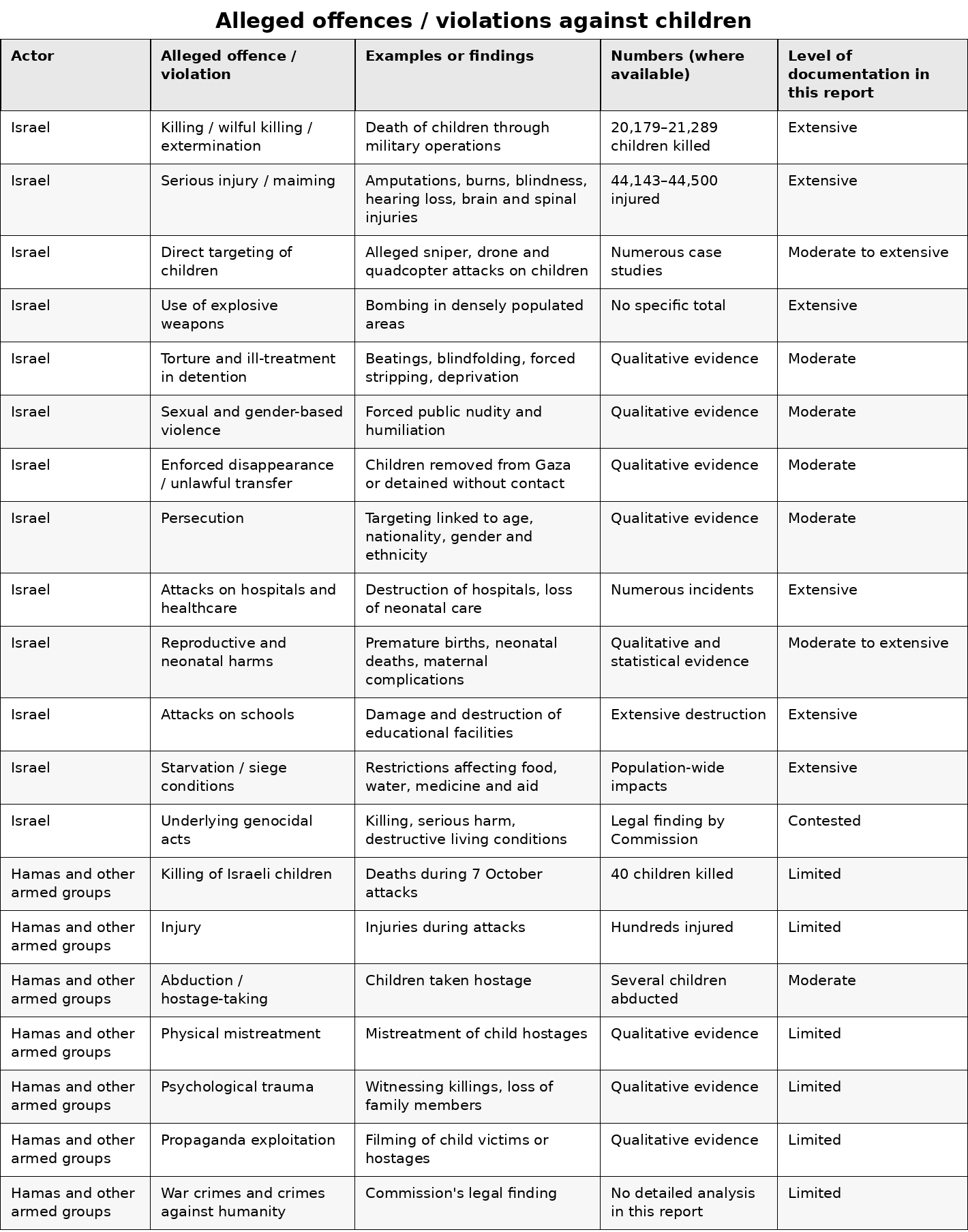
[Summary drawn from the report.Note that Hamas is discussed in other UN reports]
Applying a genuinely high evidentiary bar in a war zone requires accepting two propositions simultaneously: perfect evidence will rarely exist, and serious allegations require strong corroboration. International commissions generally do not apply the criminal standard of proof of “beyond reasonable doubt.” Instead, they ask whether there are “reasonable grounds to believe” or “reasonable grounds to conclude” that violations occurred. This approach has also been used in investigations concerning Syria, Myanmar, Ukraine, Sudan, and the former Yugoslavia.
The major difficulty is that this evidence comes from an active war zone. Records may be incomplete, witnesses traumatised, evidence destroyed, and access to sites impossible. Investigators often work with fragments of information rather than complete evidentiary records. And of course, there may be motivation to present the worse case scenario. This problem is not unique to Gaza.
Israel’s refusal to cooperate further complicates matters. The Commission states that it received no responses from the Israeli government. Consequently, investigators lacked access to operational orders, intelligence assessments, drone footage, targeting procedures, military communications, internal investigations, and the testimony of soldiers or commanders. Such material might have confirmed some allegations, contradicted others, or provided alternative explanations.
The evidentiary framework developed in the AJDS submission to the Royal Commission on Antisemitism is particularly useful here in thinking about claims. Different types of claims require different standards of evidence, and stronger claims require stronger corroboration. Observed events constitute evidence; legal and moral conclusions involve classification, interpretation, and inference. The report therefore contains different kinds of evidence carrying different evidentiary weight.
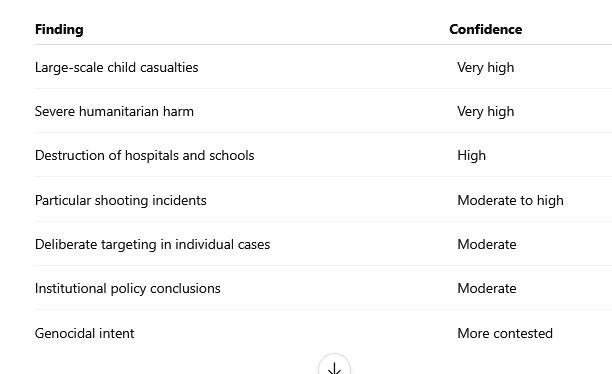
Some findings may therefore be regarded with considerable confidence. The large-scale death and injury of children, destruction of hospitals and schools, and severe humanitarian consequences are supported by multiple independent sources. Particular incidents involving shootings or attacks may also be strongly supported where medical evidence, witness testimony, visual material, and forensic analysis converge.
More contested are conclusions concerning deliberate targeting, institutional intent, or the broadest legal characterisations, including genocide. These depend more heavily on inference, pattern analysis, and legal interpretation.
Experience from the investigations and prosecutions arising from the Former Yugoslavia is particularly instructive. Early reports from Bosnia and Kosovo often relied heavily upon refugees, survivors, journalists, NGOs, and incomplete evidence because access to perpetrators and military records was limited. Serb authorities frequently denied allegations and restricted access. Many findings that were initially criticised as speculative or politically motivated were later confirmed by the International Criminal Tribunal for the Former Yugoslavia (ICTY) through witness testimony, intercepted communications, forensic exhumations, military documents, and cross-examination.
The Balkan experience demonstrates both the limitations of wartime evidence and the importance of distinguishing between observed facts, attribution of responsibility, and legal characterisation. Courts eventually established that intent and command responsibility are often inferred from patterns of conduct, repeated incidents, operational practices, and official statements rather than explicit written orders. Few perpetrators issue orders to commit war crimes in direct language.
The distinction between commissions of inquiry and criminal courts is therefore crucial. Commissions investigate patterns, preserve evidence, and identify areas requiring further inquiry. Courts determine individual criminal responsibility. The Gaza report more closely resembles the early Bosnia investigations than the later ICTY trials.
Compared with other war-crimes investigations, the Gaza report is neither unusually weak nor unusually strong. The Syria Commission relied heavily on refugees and open-source evidence because of government non-cooperation. Myanmar investigations depended substantially upon refugee testimony and satellite imagery. Ukraine investigations have benefited from greater access to sites and evidence, although Russian cooperation has been minimal. The Gaza report sits somewhere in the middle: it contains extensive medical and forensic material, but limited access to Israeli sources.
Strengths of the Report
1. Legal framework
The report is strongly grounded in:
international humanitarian law,
the Convention on the Rights of the Child,
Geneva Conventions,
occupation law,
Rome Statute provisions.
2. Child-centred approach
Unlike many conflict reports, this one places children at the centre of the analysis. It examines:
developmental harm,
trauma,
disability,
orphanhood,
neonatal health,
education,
psychological injury.
3. Methodology
The report discusses:
witness interviews,
forensic analysis,
CT scans,
geolocation,
open-source investigations,
medical evidence.
4. Case studies
Detailed cases such as Hind Rajab and children allegedly shot during evacuation make the report more evidential than purely statistical.
Weaknesses
Prosecutorial tone
The report often reads more like an indictment than an inquiry. Terms such as:
“dehumanization,”
“systemic impunity,”
“grave policy failure,”
move beyond legal description into moral interpretation. This may be useful at a political level, but an increase the suspicion that there are political motives interfering with the interpretation of evidence
Limited engagement with Israeli explanations
Israeli explanations, when they are available, are often summarised briefly before being rejected. Critics may argue that alternative explanations are insufficiently explored, even if they are not adequate.
Blurring of fact and interpretation
The report sometimes moves between:
factual findings,
legal conclusions,
ethical judgments.
This can make it difficult to distinguish what is established fact from interpretation.
Alleged Violations
The report alleges that Israeli actions against Palestinian children include:
killing and maiming,
deliberate targeting,
attacks on hospitals and schools,
torture and ill-treatment,
sexual violence,
unlawful detention,
starvation and siege conditions,
destruction of healthcare,
attacks affecting newborns,
persecution,
acts potentially amounting to genocide.
Regarding Israeli children, the report states that Hamas and other Palestinian armed groups committed:
killings,
injuries,
hostage-taking,
psychological harm,
mistreatment,
war crimes and crimes against humanity.
The report provides far greater detail regarding Palestinian children because this is its specific mandate. Crimes against Israeli children have been taken up in other reports.
Recommendations
The recommendations focus on:
protecting children,
ending attacks on civilians,
restoring healthcare and education,
humanitarian access,
accountability,
investigations,
reparations,
ICC investigations,
sanctions and international pressure.
Unlike some UN reports that emphasise policy reform, these recommendations have a strongly accountability-oriented character.
Overall Assessment
The report combines three genres:
a UN fact-finding investigation;
a legal brief;
a child-focused humanitarian document.
It is neither straightforward anti-Israel propaganda nor a completely neutral technical report. It is better understood as a highly critical human rights investigation operating under severe evidentiary constraints.
The report is therefore neither straightforward anti-Israel propaganda nor a completely neutral technical document. It is better understood as a highly critical human rights investigation operating under severe evidentiary constraints. Its strongest findings concern the scale of harm inflicted upon children and civilian life, while some of its broader conclusions remain more contestable and dependent upon inference.
Ultimately, the absence of Israeli cooperation is important but not decisive. It weakens the ability to test competing explanations and leaves important evidentiary gaps. At the same time, international investigations cannot simply cease because one party refuses access. The result is a report containing many strongly supported findings alongside some conclusions that remain more contestable and dependent upon inference, pattern analysis, and legal interpretation.