I have made a personal submission to the Australian Parliament’s Joint Select Committee on Artificial Intelligence, focused particularly on higher education and AI research. Yes, one good thing about Australia is that parliamentarians and politicians sometimes pay attention to ordinary people and may even call you to speak to an issue in person. So I am giving it a go.
Australia needs strong AI capability, research, innovation and productivity. But these goals will not be sustainable unless ethical, social and environmental responsibility are built into AI research, development and deployment. I’ve drawn work I have done in community informatics over many years, with the Community Informatics Research Network, as well as the Pope’s recent encyclical for the submission. I’m not Catholic, but I am impressed by the document, so much so that I now find myself on the Australian Catholic Bishops Conference Working Group on Artificial Intelligence and Human Dignity. Strange times, we need to stop some of evil that is out there alongside taking advantage of the great good that is to be had with this new form of knowledge creation and exploration.
My central recommendation is for a National Statement on Ethical Conduct in Generative AI Research and Development, modeled on the existing National Statement on Ethical Conduct in Human Research. Universities should embed ethics training, formal approval processes and ongoing evaluation in AI-related research and teaching—not treat these matters as an optional add-on to technical work. I don’t think neo-liberal universities and others should be left to govern themselves on this matter. The commercial imperative seems to drive everything. In fact, what goes on in AI in terms of potentially harmful effects on people and the globe is as significant as medical or scientific research. It all needs to be governed by high ethical standards. I don’t see universities, particularly faculties of technology having the skills and capacity to govern themselves well.
The risks are not only technical or managerial . Habermas in particular pointed out the contradictions between technical systems thinking and human freedom decades ago, but the culture of technology creation such as AI needs a real paradigm shift (as Thomas Kuhn would have put it). Of course we could pull in any number of other critical theorists like Marcuse, but enough for the moment. Generative AI can deepen surveillance, discrimination, misinformation, fraud, insecurity and exclusion, particularly for people least able to understand or challenge automated systems. It also raises serious questions about work, care, war, environmental costs, ownership of knowledge and democratic accountability.
Australia should develop its approach with the EU and other partners. These are global challenges requiring public accountability, civil-society participation and a commitment to human dignity and the common good.
Here are two charts from the submission and some followup reading if you are interested.
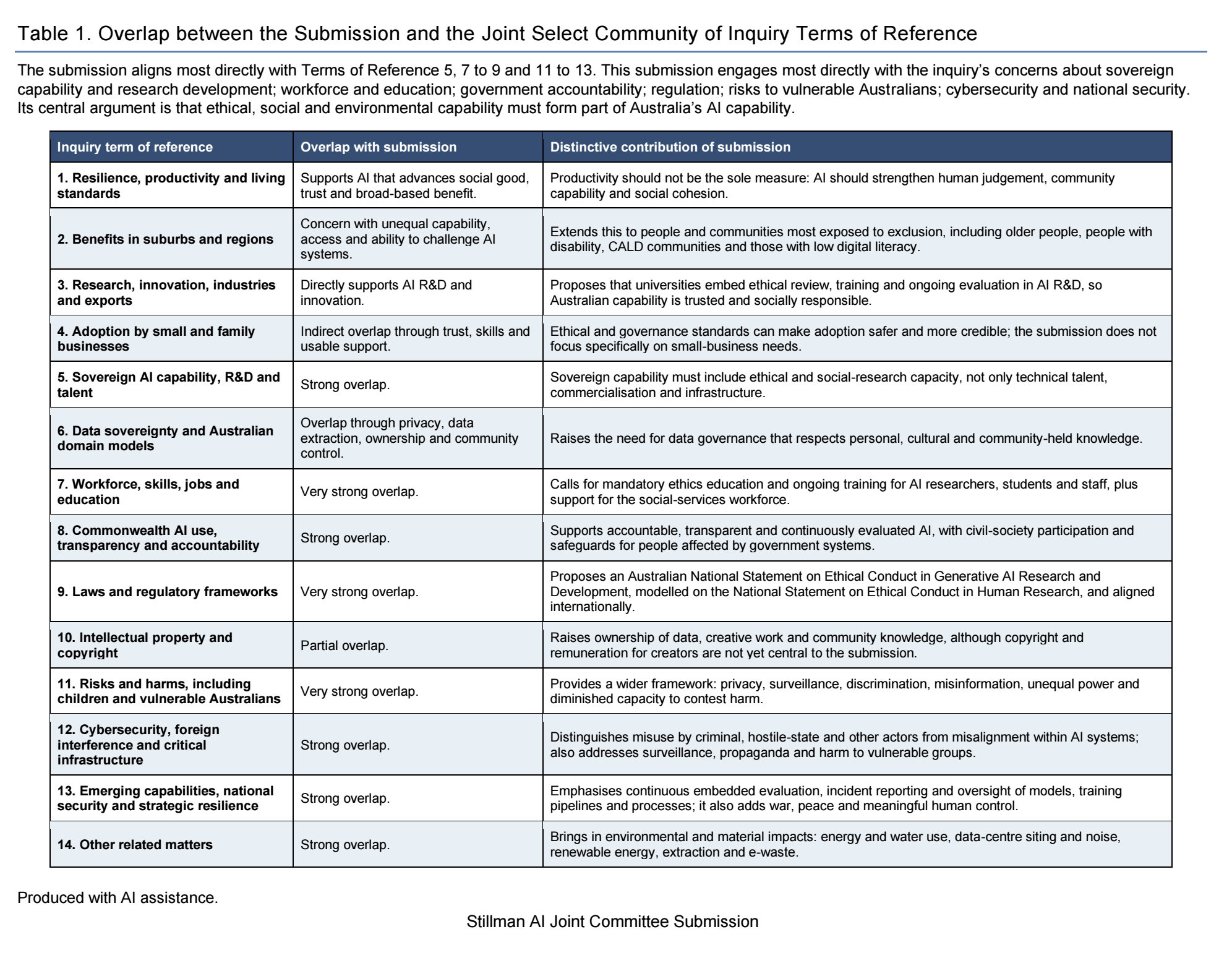
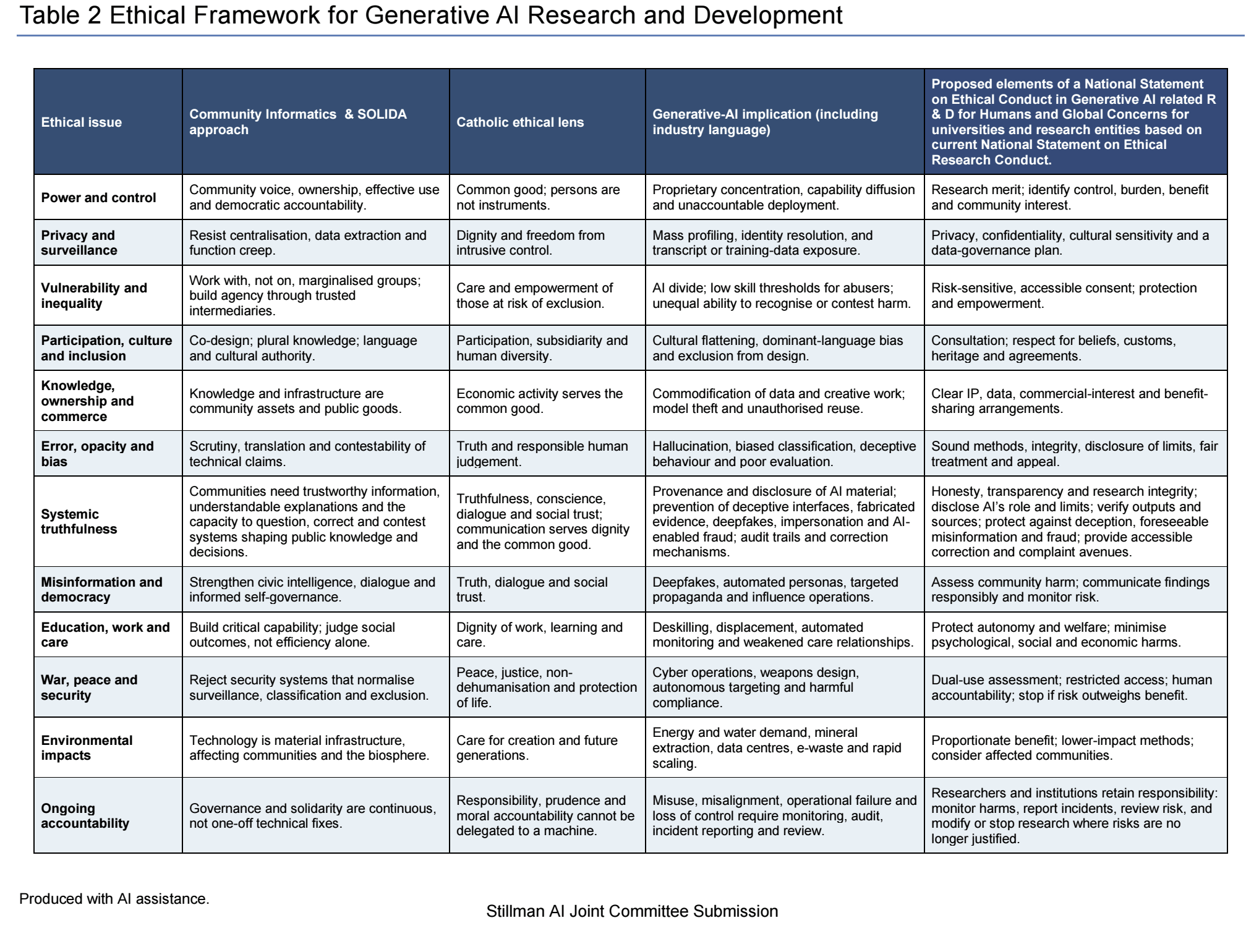
https://research.monash.edu/en/persons/larry-stillman
Amodei, D. (2026). We must pace the frontier. https://darioamodei.com/post/we-must-pace-the-frontier
Anthropic. (2026a). Alignment assessment: Cybersecurity incidents. https://www.anthropic.com/research/alignment-assessment-cybersecurity-incidents
Anthropic. (2026b). Threat intelligence report: September 2026. https://www.anthropic.com/threat-intelligence-report-september-2026
Habermas, J. (1972). Toward a rational society. Heinemann.
Kuhn. (1970). The structure of scientific revolutions. University of Chicago.
Markazi, D., Hossain, M. K., Stillman, L., Wolske, M., Anwar, M., Carbone, C., de Moor, A., Farinosi, M., Rega, I., Sarrica, M., & Zapata, C. B. (2024). A Community Informatics Research Network Vision Statement. The Journal of Community Informatics, 20(2).
National Health and Medical Research Council, Australian Research Council, & Universities Australia. (2025). National Statement on Ethical Conduct in Human Research. Australian Government.
SOLIDA Consortium. (2026). European Network for Solidarity Research in a Digital Age COST Action application
Stillman, L. (2011). A Review of “Global Challenges for Identity Policies.” The Information Society, 27(4), 269–271.
Pope Leo XIV. (2026). Magnifica humanitas [Encyclical]. Vatican.