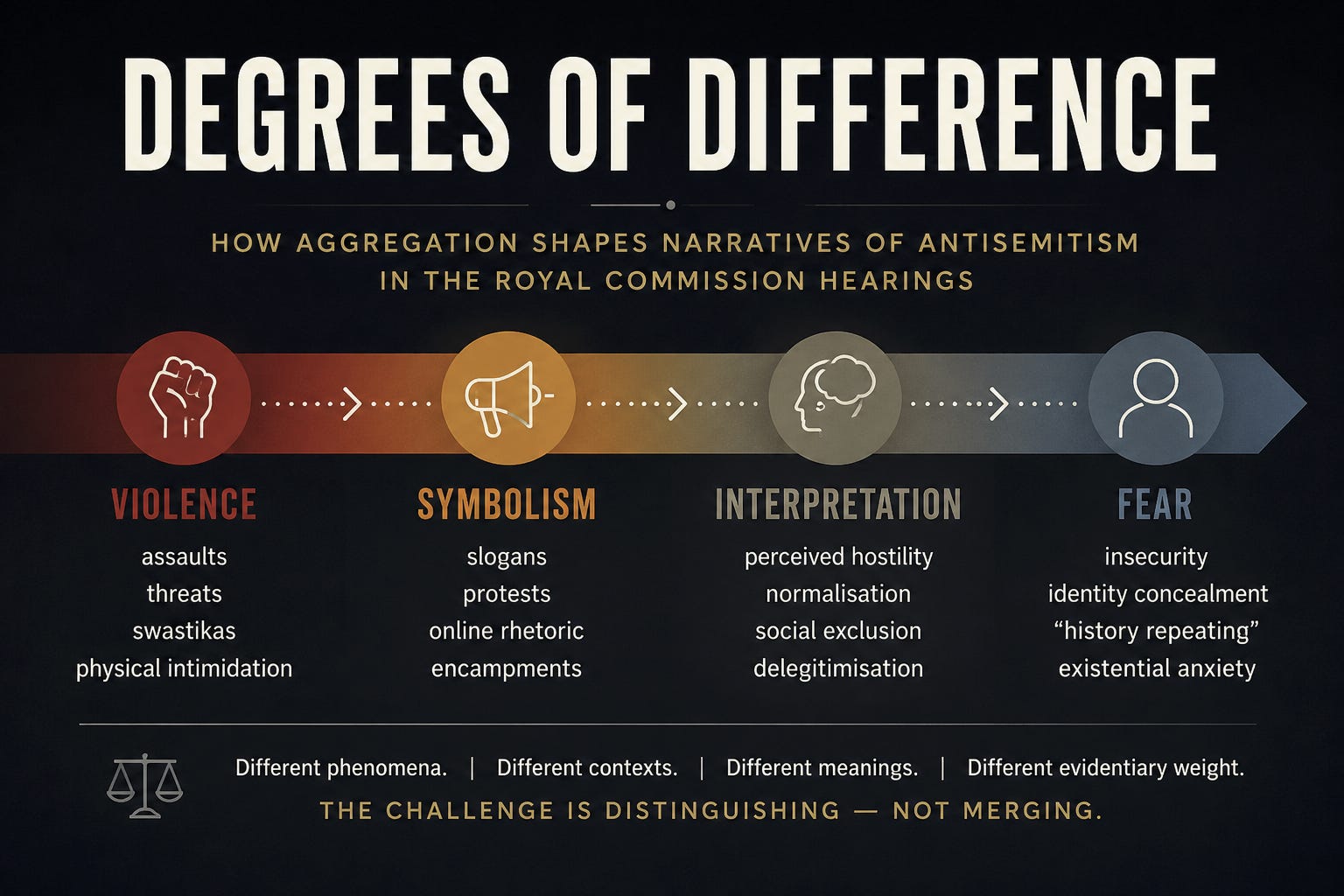
I have downloaded the Royal Commission transcripts for 4–12 May, together with witness statements currently available for 4–9 May. Some expert witness materials and transcripts are still missing, including portions of the evidence of Andre Oboler, Andrew Marcus and Dave Rich. Nevertheless, clear themes, assumptions and tensions are already emerging. Note that data analysis and writing have been assisted by AI, but the orientation and final analysis has been determined by me. The image above is AI. All errors are my responsibility.
The first hearing block of the Royal Commission into Antisemitism and Social Cohesion presented a detailed and emotionally powerful account of Jewish insecurity in contemporary Australia. Across Hearing Days 1, 2, 3 and 5, witnesses described experiences ranging from explicit antisemitic abuse and physical intimidation to online hostility, school bullying, social exclusion and fear following the events of 7 October 2023 and the Bondi attack.
As the hearings progressed, the evidence increasingly forms a cumulative narrative of civic deterioration, institutional weakness and psychological insecurity. This cannot simply be dismissed because many witnesses hold Zionist views, nor does it mean all claims are necessarily accurate. That is precisely what the Royal Commission must assess.
One concern is the lack of clarity about how Justice Bell intends to evaluate the validity and representativeness of the evidence presented. Some expert witnesses, including Andrew Marcus and Dave Rich, were questioned about the relationship between antisemitism and Zionism, but the broader methodological direction of the Commission still remains unclear. Questions also remain about witness selection and what constituencies or viewpoints the hearings are intended to represent.
The witness material nonetheless contains substantial evidence of explicit antisemitism not reducible to debates about Israel or Zionism. Witnesses described swastikas, Nazi salutes, Holocaust mockery, conspiracy tropes and direct anti-Jewish abuse. Schools emerged as a particularly important site of concern. Witnesses recounted students yelling “dirty Jew,” saying “Hitler didn’t finish the job,” performing Nazi salutes during Holocaust lessons and circulating antisemitic memes. Several described weak or inconsistent responses from schools and administrators.
One significant contribution came from a non-Jewish teacher in Tasmania who described casual antisemitic language and Nazi symbolism becoming routine in schools with almost no Jewish students. This suggests that some contemporary antisemitism functions not only through Israel-related politics but also through broader youth cultures of transgression, internet meme culture and symbolic rebellion.
A recurring theme throughout the hearings was identity concealment. Witnesses described hiding Jewish symbols, avoiding public identification as Jewish, changing transport behaviour and concealing synagogue destinations from Uber drivers. Such behaviour reflects anticipatory insecurity rather than merely reactions to direct victimisation. Many Jews already live with a degree of latent concern about antisemitism, something that may surprise non-Jewish Australians.
Holocaust memory and intergenerational trauma formed one of the dominant interpretive frameworks through which many witnesses understood current events. Family histories involving Auschwitz, Soviet antisemitism and refugee migration appeared repeatedly throughout the testimony. For many witnesses, contemporary hostility was interpreted through the lens of historical warning signs and accumulated collective memory.
This helps explain the emotionally heightened and sometimes existential rhetoric that appeared throughout the hearings. Deborah Conway described anti-Zionism as “a genocidal impulse,” while Jillian Segal warned that antisemitism had become “almost fashionable” among young Australians. Other witnesses suggested that “history is repeating” or that Australia may no longer remain safe for Jewish life. Alex Ryvchin reportedly warned, in relation to escalating hostility and violence, “I think that’s the trajectory that we’re on.” Some witnesses spoke of “the writing being on the wall” for Jewish Australians, while others implied that contemporary Australia was beginning to resemble earlier historical periods of societal breakdown and moral indifference toward Jews.
Statements suggesting that anti-Zionism is inherently genocidal, that antisemitism has become culturally fashionable, or that Australia may be approaching conditions analogous to pre-Holocaust Europe involved particularly strong forms of historical and social generalisation. The hearings occasionally moved quickly from:
personal experiences of hostility;
to broader claims about Australian society;
and then toward existential or civilisational narratives.
This does not mean the witnesses were insincere. Much of the testimony clearly emerged from genuine fear, trauma and historical consciousness. However, comparisons with pre-Holocaust Europe or claims that anti-Zionism is inherently genocidal risk collapsing distinctions between:
localised hostility;
online amplification;
political conflict;
and systemic societal breakdown.
This is where careful evidence becomes essential. At present there is evidence of disturbing incidents, but also a danger of conflating highly different phenomena — from stickers and slogans to violence and terrorism — into a single undifferentiated narrative. What is Justice Bell to make of all of this? It is very unclear.
At the centre of much of the testimony was the relationship between antisemitism, Zionism and Jewish identity. Many witnesses presented Zionism not simply as a political ideology but as deeply connected to Jewish continuity, collective survival and post-Holocaust security. Within this framework, anti-Zionism is often experienced not as ordinary political disagreement but as existential negation.
This strong Zionist orientation is analytically important because it shapes how many witnesses perceive events. Criticism of Israel or Zionism may therefore be experienced as antisemitic even when others interpret it as political or anti-colonial speech. This does not make the witnesses dishonest; it reflects the influence of deeply held historical and ideological frameworks.
The hearings also revealed a major belief that contemporary antisemitism increasingly originates not only from the far right but from sections of the progressive left, particularly within universities, activist movements and Palestine solidarity politics. Many witnesses argued that anti-Zionism had become the dominant contemporary vehicle for hostility toward Jews. Universities and progressive institutions were frequently portrayed as reluctant to confront antisemitism because of ideological sympathy for Palestinian causes or because Jews were increasingly viewed through “oppressor” frameworks.
At the same time, the hearings often moved quickly from:
specific activist incidents;
protest rhetoric;
or institutional failures
to sweeping conclusions about “the left” more broadly. Little attention was given to:
diversity within progressive movements;
Jewish non-, anti- or post-Zionist perspectives;
distinctions between anti-colonial critique and antisemitism;
or the possibility that some progressive spaces may oppose racism while still producing exclusionary effects.
The hearings also gave limited attention to comparative racism frameworks. Some witnesses acknowledged Islamophobia, anti-Palestinian racism and broader intercommunal tensions, but these perspectives were not central. Palestinian experiences were largely absent except as political context. This produced a hearing structure heavily focused on Jewish vulnerability, Jewish memory and Jewish insecurity.
The hearings therefore risk creating an asymmetrical hierarchy of visibility in which Jewish fear is foregrounded while Muslim and Palestinian experiences and those of others remain peripheral to government concerns. That is not what is needed. It should be made clear that there is an underbelly of racism in Australia, and what is being told is part of a broader problem. With One Nation about to wreak havoc and the Liberals going further to the right, we have good reason to be worried about racism being directed at other communities, and xenophobia in general.
Another major issue concerned online amplification. Witnesses repeatedly described social media environments saturated with hostility, conspiracy theories and emotionally charged content. Yet online environments are shaped by algorithmic amplification and emotion, making it difficult to determine how representative such material is of broader Australian society, distressing as such material can be.
The Royal Commission consequently faces several major challenges.
First, it must distinguish between:
explicit antisemitic hatred;
anti-Zionism;
political protest;
symbolic intimidation;
online amplification;
and subjective insecurity.
Second, it must avoid collapsing incidents of very different severity into a single statistical narrative.
Third, it must balance empathy for genuine Jewish fear with methodological rigour.
Fourth, it must preserve democratic space for legitimate political disagreement about Israel and Palestine while still responding seriously to antisemitic hostility.
Finally, if the Commission genuinely wishes to address “social cohesion,” it will need a broader comparative framework engaging more seriously with:
Muslim insecurity; anti-Palestinian racism and other racisms;
intercommunal polarisation;
and reciprocal dynamics of fear.
Overall, the hearings reveal substantial evidence of genuine antisemitic abuse, institutional weakness and widespread Jewish insecurity. Holocaust memory and historical trauma clearly shape how many witnesses interpret contemporary events. At the same time, the hearings also reveal persistent tensions involving anti-Zionism, symbolic hostility, political generalisation, emotional amplification and empirical classification. The central challenge for the Royal Commission will be determining how to recognise genuine antisemitic harm while maintaining analytical precision, transparency and protection of democratic political expression.
I just wish that Justice Bell made it more clear as to how she is going to account for other viewpoints. It is of particular concern that she has given no direct indication that the RC will take into account the views of both Jews and supporters of Palestine who put a different interpretation on a number of events. If in fact the RC feels that it has or will take those views into account, then there has been very little transparency and the matter is lost in a legal fog.
This is driving the deep suspicion and outright accusations about the purpose and conduct of the RC from elements of the left who believe that it is basically a tool to suppress Palestinian advocacy and free speech. In fact, some of the stuff online is just awful. This anger probably also accounts for the somewhat dismissive view about racism towards Jews, as if the horrors of Bondi can be dismissed because they provide “context” on Australian soil.
There are about 6 months to go for the RC. It’s got the message about how the Jewish mainstream feels about things. Now it needs to also hear from others, whose views are not all the same, either.